Friday, January 11, 2013

the magic portal. . . .


Poor Luther.

He's allergic to something, and it makes his skin go itchy. These days, he's getting baths once a week (down from one every 2 or 3 days) and taking 3 gigantic pills every morning and every evening.

I should say I'm wrestling him to shove 3 pills down his throat each morning and each evening. . . . "taking them" is a definite misnomer for this process. He does not "take" them. In fact, he's getting great practice evading them. Even the cottage cheese trick doesn't work, as this medicine apparently tastes so vile, he simply refuses to eat his dinner. And that's vile, because Luther isn't one to skip a meal these days.

Poor guy.

Then, the final insult.

"OK. I think you should put him in a T-shirt." Dr. B, his vet, said, at his last follow-up appointment.

"A T-shirt?" we asked.

"Yes. You know, just slit the T-shirt up the back a bit and then tie it around his waist after you put his legs through the arm holes and his head through the neck. This is looking like contact dermatitis, so let's see what putting him in a T-shirt will do." Dr. B is unvaryingly enthusiastic. She had merely smiled and shrugged when we incredulously repeated her initial instructions that we were to bathe Luther 2 - or 3! - times a week with some very expensive shampoo she was going to prescribe. Bathing Luther is not exactly easy.

Right, then. A T-shirt it is. It turned out that his chest is way too large for even an XL T-shirt. I slit the shirt all the way from hem to neck and attached ties. He fought it in hand-to-hand combat for the first hour, but he's gotten used to it now. He only wears it outside, so I put it on first thing in the morning, and take it off after his last outting at night. I have to be careful here, as Luther has begun to see going outside as a magic portal for food. He goes out, and when he comes back, sometimes he finds food in his bowl! Magic! When he then empties his bowl, inevitably it occurs to him that he should try the magic portal again to see if it won't fill up the bowl upon his return . . .

Poor Luther.

He tipped the scale at 160 not too long ago, and altho Dr. B didn't say it, I said it for her: "He's overweight."

She did not disagree.

We put Luther on a diet, and he's lost 20 pounds. He's looking SO much better. He's much more energetic and runs now, instead of stopping after only a couple of half-hearted lopes. Hmmm. But could he be allergic to being on a diet? That's just about when he started having skin problems. . . .

This has not been fun for any of us, let me tell you. Luther is not over-the-top food-driven - he won't eat if he's upset or nervous, for example, or if there is another dog around to play with - but he does like his chow. I don't like the fact that he finishes his dinner and it's obvious he's still hungry. I hate it that he goes to the magic portal, goes outside and comes right back in with such eager anticipation. I hate the sight of him standing in front of his bowl, waiting. Disappointed.

[sigh] Poor Luther.

He doesn't see the work of the magic portal transforming him from overweight itchy-skinned mess back to the lithe and sweet-smelling hound of old. All he sees is the empty bowl, the terror of the bath, and a T-shirt instead of his usual hair shirt.

Ah. . . . hair shirts. That's for us these days, for the keepers of the magic portal.

Wednesday, January 2, 2013

starting the new year right. . . .

WARNING: explicit religious material follows. Material which is the subject of considerable dispute even amongst the "religious." Proceed at your own risk.
___________________

The last day of the year, I received an invitation to join the Annapolis Chorale downtown to sing at Church Circle first thing this morning, Tuesday morning, January 2.

It turns out that the group of wierdos which sporadically shows up to protest at the funeral of slain soliders had threatened to show up in Annapolis to protest on the first day homosexual marriages were to be performed in our State Courthouse. St. Anne's Episcopal Church, just across the street, planned a "counter" protest:
A Celebration of God's Unconditional Love for All. On January 2, from 7:45-9 AM, we will gather in Church Circle, Annapolis, to proclaim God's love for all people in Jesus Christ. On that day, Westboro Baptist "Church" plans to be outside the courthouse to speak its words of hate. We will not engage them. But we will speak our message of love more loudly. We will lift our voices in song and praise by singing the carols of our Christmas season. Through music, song, and prayer, we will bear witness to the good news of God's unconditional love. Come and join us and let us show the world that the love of Jesus is more powerful than hate."

I emailed the Right Reverend Amy Richter asking whether or not the church intended thereby to support homosexual unions - a move I had not thought St. Anne's had taken.

I did not get a response prior to the event from her - I didn't really expect one - but I did get a phone call from the choir director. He was elusive on the question about the church stance on homosexuality. He emphasized that the message to be conveyed at the event was directed against the Westboro people, a message of love, apparently, instead of the hate perceived to be coming from them. It had nothing to do with homosexuality, as far as he was concerned. He was unimpressed with my suspicion that people would naturally assume that St. Anne's supported homosexual marriage if they assembled to oppose the anti-homosexual rants of the few Westboro wierdoes or if they provided music for the procession of the first homosexual couples to the Court House.

Here's a picture of the "God's Unconditional Love for All" celebrants at St. Anne's - which, if I hadn't been told otherwise, looks a bit more like a pro-homosexual marriage rally than a church gathering.

And here's a video of the outting. The hooting which accompanies the "dancing" in front of the courthouse is coming from St. Anne's. . . .

Really, St. Anne's?

Really?!

I am saddened that a group of 4 wierdos could escort this venerable institution into taking such a position, a position they have not taken before, and have shied away from when questioned by thoughtful people in intelligent conversations. I really don't know what to say.

There are two proverbs in the Bible which appear to contradict one another:

"Do not answer a fool according to his own folly, or you will be like him yourself." (Proverbs 26:4) and "Answer a fool according to his own folly, or he will be wise in his own eyes." (Proverbs 26:5)

As to the Westboro people, I suspect that St. Anne's would have done better to endorse Proverbs 26:4 and to have met the Westboro-4 with silence. Nothing St. Anne's could say would get through. Why speak then atall? In fact, the very fact of coming "against" a hate group puts St. Anne's in the potential position of "hating" the hate group! You should read some of the comments directed against Westboro online at the sites covering this event. . . . They were not exactly "loving."

I, however, am embracing Proverbs 26:5 with respect to what St. Anne's has done. Respectfully, this was foolish and I hope they will see that this wasn't such a good idea. You may have a nice, glowing feeling that so many people assembled in the "name" of love - but hello! - what "love" is this? Look at the fruit of your gathering. Is this what you had in mind? If not, you can clarify the record. I hope you will. God's love is indeed "unconditional", but on His terms, not ours. So actually, it is conditional. In a way, anyway. What I mean is that we can't redefine sin to suit ourselves and do away with the need for a Savior. It's been tried. . . .

The "good news" is not that we are not sinners - it's that Jesus takes away the sin of the world. We sang those very words this Christmas in St. Anne's, in our performances of Handel's Messiah.

Of course, St. Anne's could have meant to "come out" in support of homosexuality and the open homoerotic displays. Because that's just what they did. If that was their intent, my apologies, and I will shut up now, and revert to the wisdom of Proverbs 26:4.


__________________
P.S. To be opposed on religious grounds to normalizing homosexuality is not to hate those who either endorse it or who practice it. It is to say that my religious teaching tells me homosexuality is wrong and so I will not presume to say it is right. Please don't hate me for that. If you do not share that religious conviction, that's up to you. But please don't try to force me to set mine aside. Believe it or not, I have rather good reasons for believing as I do.

Oh, and bringing up either slavery, Hebrew purity laws or the historic treatment of women as your reason to re-write the Bible in this regard will only convince me to stay with Proverbs 26:4. Just sayin'.


Sunday, August 5, 2012

the cost of butterflies


This year has been a breeze in the tomato garden. Not a single horned tomato-killer/piller in sight! I did see one dried out carcass which had been taken out by braconid wasp eggs. . . . It appears that I have broken the cycle here, at least for one year. If I have no hummingbugs, at least I also have no tomato hornworms. It's a price I'm willing to pay. We have tons of hummingbirds - I'll live with no hummingbugs.

Butterflies, on the other hand, I'd be sorry to part with. We have a plethora. Yellow ones, orange ones, black ones, blue ones, white ones. OK - the white ones are moths, technically. I've written about them before. They're the ones who decimate the cabbage. And the kale. Not the butterflies, of course, the caterpillars. But without the caterpillars, there are no butterflies. . . .

This year, I was a lot more tolerant of the damage being done to the cabbage and kale by the munching caterpillars. I had planted the cabbage among the basil and parsley, and if I used chemical warfare (the only thing that really works) that meant I couldn't eat the basil or parsley for several weeks. I decided to give up on the thought of controlling the caterpillars on the cabbage so I could eat the basil and parsley, and hoped for the best. Several of the cabbages succumbed, but several others made it to table and the kale yielded regular fronds for soups, salads, and veggie portions. And I've always enjoyed the white cabbage moths flitting about the garden. They're so cheerful looking! Maybe there's something to this 'live and let live' attitude after all.

I've been looking forward to the arrival of the big butterflies and in the last few weeks, they've come on in droves. The other day I was horrified, however, to see one of my sunflowers being systematically stripped of all its leaves by an assortment of caterpillars. All fuzzy, in a wide range of colours. My first thought was - yes - chemical warfare. Death to the destructos! My second thought was "well, if I want butterflies, I have to endure the caterpillars." I consigned the sunflower to its fate. The cost of butterflies.
As it was, the caterpillars didn't kill the sunflower. They hadn't really started eating its leaves until the sunflower had bloomed, fed the bumblebees and started to fade, its petals drying to raffia and the middle of the flower turning to seeds destined to feed the songbirds here at the greenwood. A few of those seeds, of course, will be saved to plant in the spring. Cycle repeat.


No, it's not nice to have the ragged plant in my garden, ravaged by caterpillars, leaves turning yellow and brown where there are leaves at all. It's a small price to pay, though, to sustain the cycle. When the caterpillars had finished their work, they disappeared and I cut the sunflower down. I feel a bit like a murderer. They're taller than I am, with heads as large.

'Unless a seed falls to the ground and 'dies'. . . .'

There's no stopping the cycle at any one stage. The flower will wither and if I deny its leaves to the caterpillars, all I do is deny myself the joy of butterflies. And if I cut the flowers before they have been pollinated by the bees and matured, I deny myself food for the songbirds I love to see and hear, and seeds to plant next year. And if I will not harvest the sunflowers when they have dried and started to fall over, then the wind and the rain and the birds will scatter the seeds. They will either be eaten now, or rot, or if they hang on to next year, I'll be dealing with volunteer sunflowers in the paths and in between the boxwoods. They may or may not spring up where they are welcome and have sufficient soil to grow. Meanwhile, there are birds who will be looking for seed in the feeder in January and February.

Part of growing a garden, then, is tolerating ugliness. That is not at all what our culture says. Ugliness is to be rooted out. Sprayed. Eradicated. We can have it all, we are told. Beautiful fruit and leaves and seed - all at the same time - and never mind the cost. In fact, what cost? Life is beautiful. Just don't look behind the curtain. Don't question how the roses in stores are grown so big, so beautiful, with leaves with nary a spot or blemish on them. Or the sunflowers at the supermarket: each perfect, none contaminated by the touch of any bug, let alone the munchings of a caterpillar. I begin to see their perfection as a deathcamp. Neither fertile nor food. Poisoned. Their "beauty" pales when I consider what chemicals enabled it.

I have written before that growing one's own food has made me much more tolerant of imperfections. Now, I learn to tolerate even ugliness. Everything, in its season. We don't want the seasons, though, do we? We want the cool when it's hot, and the hot when it's cold. We want to be young forever, and to be wise without the years. We want to keep our options open and to be able to be where we are not. We 'conquer' time and space with facebook, skype and instant messages and wonder why we never really talk any more. Talk, sitting down, face to face, munching on the produce of the garden with the messiness of dishes afterwards and a greasy grill.

The cost of butterflies, indeed.

The title notwithstanding, I reject the utilitarian cost/benefit framework. No, I see this squarely within an Aristotelian conception of the good life, helping me to make sense of what I would not easily call "good" absent a wider perspective. It's the wider perspective which, in the end, leads to the transcendent, and the transcendent, to God. Because like the grass and the flowers, we, too, fade. . . .


Friday, July 13, 2012

lessons from the garden


Weeding and Watering.

As you may have determined by my last post, I have a laissez faire approach to weeds. If they are pretty and behave themselves, they may stay. If they're ugly, they get ripped out right away. Likewise, if they encroach, smother or otherwise impede the growth or flourishing of the lawful plants (read: beans, tomatoes, peppers, cabbages, basil, herbs, recognized flowers, etc.), they will be uprooted.

Today was an uprooting sort of day.

I learned last week, to my dismay, that a half hour or so of water every other day (or so) may dampen the top of the soil, but does absolutely nothing where it counts: deeper down, where the roots are. Another 15 daylilies had arrived from our friend Don at - what IS his farm's name again? Lily-something. The queenmum will surely supply it in the comments. Anyway, digging deep holes to place them in revealed the water shortage. A half an inch down, the soil was bone dry. I'd been making much of how much time I spend in the garden watering and etc., but it sure hadn't accomplished anything! Note to self: if you're going to water, you have to water. Water like you mean it.

Out this morning, watering like I mean it, I learned another lesson: weeding helps with watering.

As I watered, I absent-mindedly pulled out some grass and the occasional ugly weed. Their roots not only brought the dry soil to the surface, but also left an avenue for the water to soak down into the soil. I crouched down, then, with the hose, watering and weeding at the same time. Three hours later, my compost bin is full, my legs and back are a bit sore, and the garden looks refreshed - but the soil probably still needs another couple of hours' worth of water on it!

How I wish it would rain. . . .

More than ever, I appreciate the parables in which Jesus talks about gardening. Preparing the soil, pruning, good and bad fruit, dealing with seeds, fertilizing, weeding, watering - He talks about it all. And as I do all of those things in my little garden, I think about how He is doing all of those things in my life, in the lives of those around me, and all the way up to our country, other countries, and the whole world. There is a time for everything, isn't there? Well, I see some weeding and some watering in our future. And I'm going to spend some more time re-reading the gardening parables.

Wednesday, July 4, 2012

iron root


Some years ago, I attended the funeral of a wonderful old woman who came from the Tidewater Virginia area. It was a hot, summer day, and we drank lemonade, ate cucumber sandwiches and told stories about Nan.

Walking around the old church grounds I spied a beautiful purple flower in the lawn, growing in the grass. The pastor clearly thought I was a bit strange, but readily gave consent to dig one up and armed me with a spoon and a paper cup with which to do so. It was no easy task, but I finally succeeded in getting a plant with a bit of some root to it. I prepped it for travel, and popped it into the ground when I got home. Some days later, it seemed to have disappeared. Oh well. Probably just as well. I had no idea what it was, and was vaguely worried lest it have invasive weed-type qualities. With those wire-like roots, they could cause a problem. I would always remember the day of Nan's funeral, and didn't need the little purple flower to remind me.

The next year, two or three sprigs popped up which I suspected were Nan's flower. I left them in place, even though they did not bloom that year. The year after that, there were considerably more sprigs, with flowers. They were pretty! There was only one problem that I could see, and that was the roots. They are incredibly difficult to dig out of areas they have strayed into, into which you do not wish them to roam. The plant stands a foot tall, and seems to spread by root as well as by seed, as they began to be seen popping up well beyond the reach of the first transplant. I begin to suspect I have a problem.

"Does anyone know what this plant is?" I posted on facebook a week or so ago, with a picture of the plant in question. The picture above, in fact. Almost immediately, a friend posted a possible identity. "Wild Petunia?" she questions.

I hadn't even heard of a wild petunia. But at least I had a place to start my research. "Weed with purple flower" hadn't given me anything. "Wild Petunia," however, turned up immediate pictures that confirmed that my flower was indeed a wild petunia, or Ruellia. As I continued reading, my worst suspicions were confirmed. Although there are Ruellias which are lovely and well-behaved, mine apparently are not.

Note to self: Before you go to all the trouble of digging up and transplanting something you suspect might be weed-like in its growth habit, do some research first. If it has a common name like "iron root," by all means DO NOT PLANT IT.

Next up, the Ruellia relocation program. I think I have just the spot where - if they can survive - they may happily spread out and make themselves at home. I hope they make it. Actually, I hope I succeed in digging their iron roots out of the cucumber patch! I'm sure I will. Anything associated with Nan wouldn't even think of ever making a nuisance of itself.

And I've learned a valuable lesson.

Saturday, June 23, 2012

the state of the garden


I'm a little nervous.

The tomatoes have set fruit, a lot of fruit. Meanwhile, the basil is already trying to blossom - so I'm constantly snipping it, trying to keep it at optimum tenderness and flavor for the tomatoes once they start coming in.

Yesterday, I harvested four (4!) zucchinis. You should see how many tomatoes are on the plants, just biding their time. When they start coming in, it's going to be an avalanche.

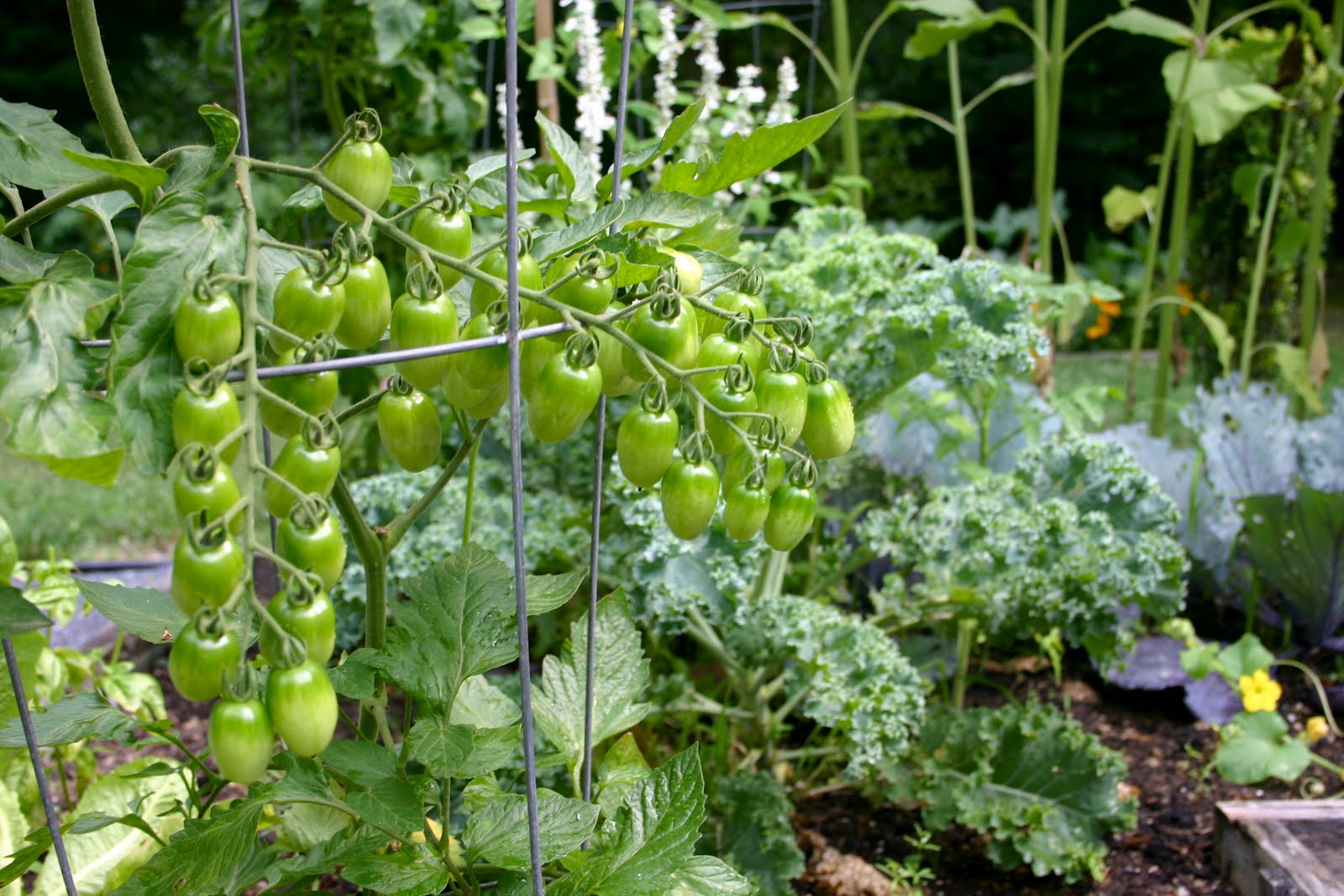
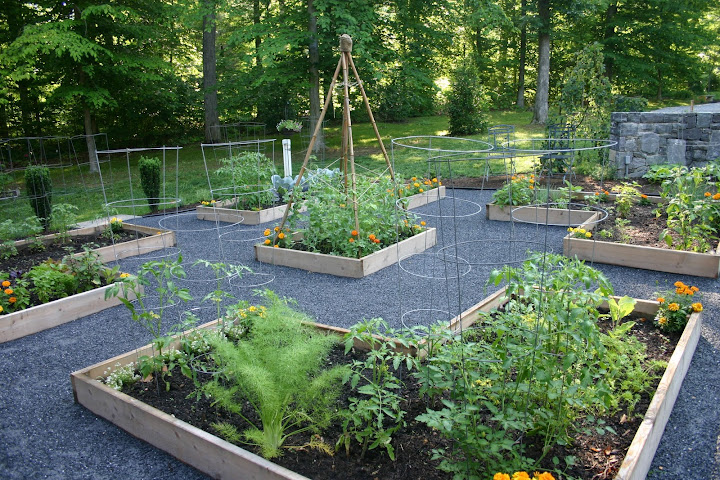
I don't know what it is, but everything is bigger this year. These are "grape" tomatoes in the picture above, but they're almost the size of Romas. The sugar snap peas reached to the top of the centre tee-pee, which they never do. The purple-podded pole beans have already started coming in, overlapping with the sugar snap pea harvest. This, too, is a first. Overnight, purple beans appeared, up to 7 or 8 inches in length! (OK, maybe not overnight, but it seemed like overnight! One day they weren't there, and the next day they were there with a vengeance.)

Here's a picture to prove the point. This was on June 18th. Last year, the first tiny bean wasn't spotted until July. They coincided with the beginnings of the first ripe tomatoes.

Since then, I've harvested about the same amount as in the photograph above, every second day. The so-called "cherry" tomatoes are almost the size of Early Girls, and are just getting an orange/reddish tinge. The Beefsteaks are mammoth. Here are the Brandywines, almost as big as the Beefsteaks - and even prettier, with the kale in the background. Who would think that this was only mid-June?! I'm looking over my shoulder, expecting disaster, somehow. No sign yet of the dreaded tomato hornworm and, so far, the deer have kept their distance!

Nonetheless, I can't shake the feeling that disaster is lurking . . . just around the corner. Sigh.

Well, time to figure out what to do with this basil and these zucchinis. For good or ill, it's what's for dinner.

Friday, May 11, 2012

friends of friends. . . .

Three years ago I got a call from the queen-mum.

"Go to the parking lot of Twist Salon. Under one of the trees there you will find several shopping bags of iris bulbs. Yellow, I think. They're for you."

"Ah - thanks?" Yellow is not my favorite colour, although I tolerate it in daffodils. It's also grown on me in zucchini blossoms. But yellow iris? Meh. Still, free plants are free plants (and moreover the queen-mum would be advised if I failed to cause them to disappear) so I dutifully made the trip, picked them up and took them home. I felt a bit like an undercover agent . . . .

Thereafter, the iris bulbs languished all summer in their shopping bags, moved from one spot at the greenwood to another. I couldn't figure out where to put them where they wouldn't take up valuable sunny real estate which I didn't really want to waste on them! I finally got them in the ground just before the first frost. I put them next to the wall up front where I figured nothing would grow, primarily because the ground there is harder than iron! Thank you, Tom-builder. I scratched a couple inches deep, threw them in, covered them and called it a day. If they could grow there, I figured, they were welcome.

Each summer thereafter, they have put up leaves, but nothing else. This summer, finally, flowers. Those flowers, above. They're kind of nice! What's more, they remind me of Debbie, the woman whose garden they came out of.

Come to think of it, many of our plants have travelled via friends and former houses. It enriches the garden and builds in memories. . . . The Ligularia out back came by way of the king's former house, as did the black mondo grass. We have miniature mondo, a painted fern and a red maple from our rental abode during construction. The black-eyed-susans came by way of another Debbie and are slowly taking over the place. The rosemary is almost all from the queen-mum, as are the Lysimachia and the daisies that just arrived a few weeks ago. They are all friends, and friends of friends.

In the words of Spock: May they live long and prosper.

Wednesday, April 25, 2012

beans

I've learned quite a lot about beans since we've lived here at the greenwood. I started with Thomas Jefferson's hyacinth bean, which turned out to be beautiful, but potentially poisonous. The king objected to its wayward ways, obliterating the front walls with its foliage. He is not moved by blossoms.

I moved on to the more conventional bush bean which, although more restrained in its growth habit, requires prolonged stooping to search out and harvest the beans. Plus, the deer find the bush form much easier to graze the leaves off of. . . . Back to the drawing board.

From Baker Seeds, I ordered Scarlet Runner beans and the Purple Podded Pole bean. The Scarlet Runner bean flowers early and starts producing beans reliably all summer - but I was not a fan of the slightly fuzzy skin. It's not bad, but the purple podded pole beans were beautifully smooth and the purple pods much easier to spot and harvest. Their drawback? They start producing later in the season, but when they start - do they ever start! They produce well into the fall, if you keep harvesting the beans.

Then last year, my globe-trotting parents brought home several packets of beans from various ports they'd called into. I planted several of what I felt certain were bush beans - just to humor them - only to discover that the beans were rampant runners. I erected towers under them and let them climb among the tomatoes. The beans were slow to start, but delicious. They have smooth skin and stay tender well past what I had learned to expect of bean sizes. These were called "Perfect" Judios. Judios apparently means beans! Looking it up now, however, it also apparently means Jews. . . .

I agreed. These were just about perfect beans. Eating-wise, anyway. For this year, I planned to stay with the Perfects and the purple podded pole beans. No Scarlet Runners. Sorry! But then my parents came back with more packets from foreign ports. Oh dear. Here's a close up.
Look at those colours! (I have since decided that perhaps the fungicide they put on packeted beans is coloured. . . . surely the lima beans are not fuchsia? We'll see.)

Which brings me to where to put them. . . .

You know those ugly pvc pipe caps builders insist upon putting right next to your house? (and does anyone know what they're good for?!) We did this:

It does get sun part of the day - just not first thing in the morning, the time of this shot. Meanwhile - I've put in some of each type of bean at each trellis.

Should be fun!

Saturday, April 14, 2012

the owl in the woods


I hear him when I wake at 3 a.m.

I wake often at 3 a.m. - I'm not sure why. Someone once told me it was the hour of evil spirits and ever since then, I turn to prayer as soon as I'm aware enough to realize I'm awake. Inevitably, I fall asleep again almost immediately.

I love to hear the mournful cry of the owl, though, before I fall off.

This morning I was up at dawn to bake a promised loaf of bread. Just outside the back window, our owl sat on his branch. He moves his head like a cat, looking and diving his neck and - yes - turning it almost all the way around to look completely behind him. He's full of motion for all that he is also completely motionless. In the picture, certainly.

Voles, beware! Actually, I'm hoping they will take no notice of him, and that the owl in the woods will take up residence in our clearing, and clear out the voles.

Saturday, March 3, 2012

words, pictures and facebook


Has it always been so that books have been lauded as a good way to educate, inform, inspire and entertain? I think so. Perhaps novels were not always so enthusiastically received, but that's largely changed in these times.

Television, on the other hand, is largely reviled, even as we all watch it. I read somewhere that 100 years from now we may well remark on this time as the great lost years, much as gin soaked - and sucked up - the life out of those who lived during the Industrial Revolution. I'm sure I book-marked that idea, but where? It's an intriguing premise. I wish I could tell you where I found it.

Both books and television serve as an escape, but we applaud the reader's escape, not the TV-gazer's. Perhaps the difference has to do with pictures. Not the single picture that adorns the frontispiece of novels (which usually look nothing like what you imagine of the hero or heroine), but the moving pictures which tell the story in movies and television, and thereby remove it from our imagination.

Books work with words and ideas, and require the interaction of the reader's imagination. We read; we think; we picture the story or the ideas in our imagination and it becomes real to us, and can be made real in our actions and by what we do as the result of what we have read and thought.

Movies do not require the same interaction. They require some attention, perhaps, but act upon us, rather than with us. I watch the recorded action as an observer and only imagine that I am a part of what I have observed merely because I have observed it.

Maybe the Biblical injunction against making images is about what happens when we set those images in front of a people that then stops creating, or even co-creating. Art doesn't make me just want to sit down in front of the picture, it inspires me to view things differently, to think new thoughts, or to change my surroundings or even myself. I begin to think that the difference between prohibited 'images' and art lies in where the life is. Is the life in the people viewing it or reading it? Or is the image itself held out as life, or held out as what life ought to be, somehow, if only we were right?

Years ago, north of Barcelona, I met an artist who hosted a conference on "kitsch" - which she defined as the attempted depiction of ultimate good, or heaven, even. Something bad happens when you try to capture that much reality in a single dimension. It turns on you and becomes not only dead, but deadening. "Virtual reality" promises more than reality - right before it robs you of any reality you otherwise had. Then it shows that it's dead and drab. No life; no colour.

I begin to suspect that something similar is happening on facebook. It promised more than reality: instant access to friends, family and a virtual community, any time and any place. But the easy re-connection with old friends now takes more and more time and gives less and less. We're like junkies, our faux-community requires ever-increasing facebook hits.

Facebook presents only the illusion of life. It gathers information about my internet habits by which to tempt me with ads for products I can buy to make my life complete. My friends and family gradually fall silent under the pressure of coming up with something clever to say or finding the perfect photo to show our perfect lives. Meanwhile, we post photos of puppies and kittens, slogans, and links to articles that are helpful, infuriating, or shocking. We link to people we don't know who've written about thoughts we no longer think for ourselves.

Life is face-time, not facebook. Ultimately, life is what happens outside of facebook.

This might be one 'book' that doesn't make the cut.

Meanwhile, if Downton Abbey were a book, I'd be reading it. . . .

Wednesday, February 8, 2012

building and book reports. . . .


Gretchen Rubin is a lawyer who clerked for Supreme Court Justice Sandra Day O'Connor, but gave up the full-time practice of law to write books. She's written several, and I came across her while she was doing research for her book The Happiness Project. In March, that book will have been on the New York Times Bestseller's list for a year. She's hit a nerve, I think.

A lawyer myself, and a writer, and one who has also studied Aristotle in the quest of understanding more about what's important and what makes us happy, generally, I feel a bit of a kinship with Gretchen. Accordingly, I was quite interested when she listed Christopher Alexander's A Pattern Language as a book that "changed the way I look at things."

Paradigm shifts are energizing, don't you think? Picture standing on your desk, like the students in Dead Poet's Society - the view really is different! It can jumpstart thought, or give a flash of inspiration. To an artist or a writer - or anyone, really - it is a good thing. This was a book I wanted to read.

It turns out that The Timeless Way of Building is actually the first book, and describes the theory behind A Pattern Language. A Pattern Language, then, is the "working document" for the resultant architecture. First things first, eh? Moreover, the local library did not have Pattern Language, but as it did have The Timeless Way, I read it, first.

The book consists really of a single idea: that there are inherent 'patterns' in the way we live as humans, patterns which ought to (but often don't) shape the buildings, towns and cities we live in.

That's the book, in a nutshell. Alexander argues at length that we have lost our connection with those basic patterns, and that the current state of architecture and design is bankrupt. This is why, he argues, many of the spaces we inhabit are 'dead'. Dead spaces, he says, are deadening also to our lives. The converse is also true: that 'living' spaces inject life and freedom back into us. The trick is to become aware of the patterns which are "life-giving" and to re-incorporate them into our living spaces. But it's not just incorporating patterns that is important, it's about learning who we are, when we are least aware of ourselves. He does not advocate a slavish adoption of rules and patterns, he attempts to translate living patterns into language, which we can use in dwelling spaces much as we use words strung together as sentences. Ultimately, he says we transcend even the patterns, and that's well and good.

"The more I watch our pattern language being used, the more I realize that the language does not teach people new facts about their environment. It awakens old feelings. It gives people permission to do what they have always known they wanted to do, but have shunned, in recent years, because they have been frightened and ashamed by architects who tell them that it is not "modern." . . . The impulse to make windows overlooking life, to make ceilings vary in height, columns thick enough to lean against, small window panes, sheltering steeply sloping roofs, arcades, seats by the front door, bay windows, alcoves, [and hidden gardens] is already part of you. But you have been told so much, that you no longer value these inner impulses. You curb them, because you think that someone else knows better [or] that people may laugh at you for being so ordinary. A pattern language does nothing really, except to wake these feelings once again." [pp. 545-47]


The writing often feels redundant, and good examples are few. There are wonderful pictures of 'living' spaces, which the author fails to comment upon, happy to let the (often poor-quality) picture speak for itself. The pictures do speak for themselves, but I would have loved to have had the author's commentary about details, and help to see it even better. The value of this book is that the main idea is just so good. The drawback is that he spends more of his time trying to get us to agree with his main idea than showing us how it works, once we're on board with it. It's likely that the drawbacks I've listed here are remedied in the next book. Note, too, that this was published in 1979, and there are aspects that feel dated.

Gretchen Rubin is right: it will change how you look at things. I expect that I will spend years perfecting my understanding of the "patterns" that delight me, and which we incorporate into our lives and the spaces we inhabit. I wish I had known more about these patterns when we were designing and building here at the greenwood. . . . Especially about "window places" and "windows opening wide" and "sheltering roofs".

As it is, we have a good amount of roof overhang - every inch of which was hard-fought from first our draftsman and then our builder. I would have fought harder for certain doors to open outward. ("That's just not how it is done." I was told, and stupidly, I let it drop.) I would have brought certain window sills further down to floor level and incorporated a deeper sill. There, as I recall, I was told that the building code prohibited windows from extending too far down to floor level without. . . . whatever it was. We won the battle of the 'small window panes' - but were first subjected to comments like "But everyone agrees that picture frame windows are better than cutting up the view with lots of divided panes! You really want divided lights windows? You'll regret it. . . . ." I would have felt ever so much more secure if I had known of this "pattern" and how it makes people feel comfortable to dwell there. I could have withstood the criticism and implied ridicule ever so much easier. As it is, I feel somewhat vindicated now, especially as I also see the thickened walls, varying ceiling heights, steeply sloping roofs, the arcade, columns thick enough to lean against, and the seats at the front entrance. . . . Elements we included without having named them; elements we were made to feel vaguely ashamed of, for even wanting. It was not a matter of luxury, but a matter of feel. "Feel" is apparently not an element that is highly valued in the building trade.

For anyone wishing to understand a bit better how we inhabit the spaces we inhabit - and how we can better inhabit them - this is a great place to start. I think I'll have to bite the bullet and purchase the next one as well - A Pattern Language
- the one that details the 200 plus patterns Alexander identifies as significant in our gardens, buildings, towns and cities.

I'll report back once I've made my way through that one. Meanwhile, The Timeless Way of Building is going back to the Library - if you want to check it out. . . .

Wednesday, February 1, 2012

Spring?

Surely it's not spring yet. It's just the first of February! But the blackbirds have started their spring ritual of flocking and turning the leaves over in the forest.

It's birthday season here at the Greenwood. There are an amazing number of women in this family who are born in the first week of February. And this week we're also gathering for a baby shower to welcome a new baby girl who will miss out on the February festivities - but who will be extending the birthday bashes into March.

Yes, I've been knitting.

My friend Sarah - who used to publish conservative commentary here has had her time largely taken up by her girl toddler and keeping her in hats and other adorable knitted things. Which I now know from facebook and not her blog. Most recently, she's been adorning barrettes with crocheted posies and caterpillars. (again - facebook. Sorry! But here, I'll give you a peek at the caterpillars.)

With that inspiration, I tried my hand at a flower to spice up this little knitted cloche and bunting bag I made for the new baby expected in our extended family. . . .

Is this cute, or what?!
Pattern: cast on 7 sts. Slipping first stitch of each row:
Row 1: Knit
Row 2: Knit
Row 3: Purl
Row 4: Slip one st k-wise, *yo K1* and repeat across the row - 14 sts.
Work in Stockinette stitch for 8 more rows, finishing with a purl row.
1st dec. row: SSK, SSK, knit across until there are 4 stitches left then K2tog twice
2nd dec. row: purl across
3rd dec. row: SSK, SSK, knit across until there are 4 stitches left then K2tog twice.
4th dec. row: purl
5th dec. row: SSK, knit 1, then K2tog
6th dec. row: purl
7th dec. row: SSK, return stitch to left needle and pass last stitch over it; fasten off.

I made 5 petals - you can make as many as you like. When you're done, you sew them together - cinching them tight in the middle. I used narrow ribbon to make french knot and running stitch details.

Have at it!

Friday, January 6, 2012

Spirello - the elf. . . .

I love this hat!

The one made for my grandson apparently was too small. This one, however, for a wee newborn, was just right! She was the hit at the Christmas Eve gathering in her elf suit, and she didn't try to take the hat off even once.

It's the eyes that get me. . . .

Instructions for the hat are pretty general, but you will find them at this link, here. Ask, if you have questions!

Wednesday, November 30, 2011

counting the days. . . .


I am amazed at how fast Christmas comes each year. Apparently faster and faster, with every passing year! But I know that this is just a common place illustration of the relativity equation. With only one Christmas season under my belt, the next one took forever to arrive. With 50-plus under my belt, they're a bit more commonplace these days. . . .

I like this season. I like it perhaps better than any other season because it brings magic and wonder back into our lives as possibilities.

In that frame of mind, I present to you this year's act of whimsy: the Christmas elf hat. Yes, I've made one for my grandson, that magical wee man!

I used Lion Brand Cotton Ease - and (giving due credit to Elizabeth Zimmerman, whose Snail Hat was a basic inspiration) -

HERE'S THE PATTERN:
Spirello, the Elf Hat. . . .

With size 8 double-pointed needles cast on 65 stitches and distribute amongst your needles. join and knit 5 rounds for roll-up brim.

Begin spiral pattern as follows:

Row 1: *K 10, M1 (which means= make one stitch using backward loop method), P 1, P2 tog - repeat from *.

Repeat that row 15 to 20 times - or until you wish to start decreasing. Here, suit yourself as to how fast to decrease. The fastest decrease is simply to omit the "M1" in Row 1. What I did was to start a bit slower, omitting the M1 in one Row 1, then working 4 or 5 pattern rows before again knitting a Row 1 without the M1.

Things get a bit complicated when the knit sections get down to 2 stitches and below. . . . You can either keep it to a K2, P2 tube, or continue a spiral by working K, Kf&b, P, P2tog. Decrease further as you think best - I did: K2tog, P2tog - and worked in K1, P1 ribbing for a bit before cutting the yarn and running the end through the remaining stitches and pulling tight.

I worked the ball in sock yarn, using #1 dp needles, and this pattern HERE, posted by "Em-En" at I Like Lemons.

I only increased to the K4, Kf&b stage - then knit 3 rounds - and then decreased starting with K4, K2tog. I stuffed the ball with fiberfill before the opening got too small, and then knit the remaining rows and fastened off. I also picked up the stitches directly on the hat, rather than casting on separately and then sewing the pom-pom on. . . .

I like that they will stand on their own:


And for those interested in EZ's Snail hat, you can find it in her book Knitting Without Tears - which is a game-changer for most people who knit and who've read it. . . .

Saturday, November 26, 2011

missing inaction. . . .


I've been an abominable correspondent. No excuses. I have nothing to point to that has kept me so busy I couldn't write. In short: it's not that I can't write - or couldn't write - the fact of the matter is simply that I haven't written. sigh. Here's were inertia sets in, and months of not writing can weigh you down to another half year of silence, which inevitably leads to a year and more of silence, and then. . . .

Well. Better dust myself off and get going, then!

The summer has come and gone. Yes, I know that the "Current Season" stayed at "the height of the summer" on this page until just today - November 26 - two full days after Thanksgiving. I have firmly resisted the urge to skip straight to winter just in case I don't get back for while. No, I've changed the "Current Season" picture to the one above, for fall: "Greenwood blackbirds". This time of year, they gather together and flock in our woods by the thousands. What a whoosh they make when the take off in concert and wheel about!

Now that Thanksgiving has come and gone, thoughts of what to make for Christmas occupy my mind. Here's one project I came across that I hope to make for the Greenwood tree inside: Edgar, the Raven, by Stacey Mead, who blogs over at The Goode Wife of Washington County. I LOVE her whimisical designs!

I can just see several of these fellows in our tree this Christmas. . . .

You can order her patterns at this link: Raven's Haven Patterns.

Tell her Queenie from the Greenwood sent you. I think she's incredibly cool.

Meanwhile, it's not quite dawn yet - so time for some more coffee before the day begins. For today, it's back to the herbs for me, and putting together this year's herbes du bois vert. I also have several elephant ear bulbs to dig out of the ground and winterize. . . .

More inaction to keep me from writing! Here's hoping to overcome inertia.

Wednesday, October 19, 2011

darkle. . . .

There is such a word as "darkle" - a word I've put into the beak of a rhyming crow - and is in play outside today.

The word, that is, not the crow. It's a darkle day. . . .

Saturday, September 24, 2011

four years ago today. . . .

. . . . from the archives:


Today's is Elizabeth Perry's 1000th consequtive posting of sketches and musings over at Woolgathering and as part of her online celebration, I am posting my own sketch.

I lost my wedding band this spring
[which would have been the spring of 2007].
I was out in the garden, preparing urns for a new batch of annuals to be nestled in with the evergreen ivy. It wasn't until hours later - washing my hands - that I realized it was gone.

"Where were you?" he asked, when I came back in an hour later, still crying, still without it. I shrugged, helplessly. I'd been everywhere. We looked everywhere. We dug up everything I'd planted. We sieved the dirt. Over the next week we bought and read the manual for a metal detector and struggled manfully with said detector. We dug up the plants again. I cried some more.

I wrote about it; dreamed about it; prayed about it; pondered the why's and wherefore's of it. Not to mention the where-the-hell-is-it?!!'s. I couldn't find it and it didn't turn up. We still look for it, walking in the garden. My empty left ring finger was a mute accusation of my carelessness. How could I not have felt it slip off?! Strangely, I felt like I had failed as a wife. This was the symbol of our marriage - our treasure - and I had proven untrustworthy in guarding it. I lost it! Way to go. . . .

No, I didn't tell the king that. But neither did I press to get another one made. I started feeling unreliable with respect to my engagement ring and rarely put that on. . . . Fine. I didn't wear rings before I got married - just a few years ago - so what's the big deal? I won't wear rings now. Clearly, I'm not to be trusted with them.

Still, when I least expected it, a wave of loss would wash over me and I would finger my married ring finger, feeling the missing ring like I hear people who've lost limbs still feel them. How silly to feel such desolation over a ring. A piece of metal. OK - platinum metal, and have you checked the prices on platinum lately?! But still. I just missed my ring.

Last week, in the middle of dissertation hell, the king and I went out onto the porch for a happy hour glass of wine before dinner. The squirrels have been at work in my garden and urns, busily burying and unburying nuts and such. I scolded one of them who came within earshot: "I better not catch you in my urns! I'll whup your butt!" The king and I laughed. "Unless, of course, you find and return my ring," I added. "Then you can dig in the urns all you want!"

"You really think you're going to get it back, don't you?" the king asked.

"Well, I hope I will." I said. "I'd kind of lost hope there, for a while, but now I find myself looking again, quite expectantly. Almost as if it will be brought to me and left on the front steps. . . . But I haven't found it yet." I smiled. So did he. He went inside a moment and came back out.

"I didn't know when to give this to you." he said. "Now seems the best time." He placed a little box on the concrete bench we use as our coffee table on the porch. I started crying. (and I've started crying again, thinking about it. . . .)

I can't believe he had another ring made for me. Just like the first one. The one that's lost in our garden. The one that matches his.

This one is just a little different, though - I can't quite put my finger on it. But it's growing on me. Like a second chance.

*******************
Thank you, my dear king.
(four years later)
xoxoxo

Wednesday, August 17, 2011

state of the union

I haven't felt real chatty this summer. The summer study has focused on the role of conflict in life and life has obliged by sending lots of conflict life lessons upon which to practice. Conflict may be a must-have for a good story, but I continue to think it's overrated in one's own life.

I could be wrong.

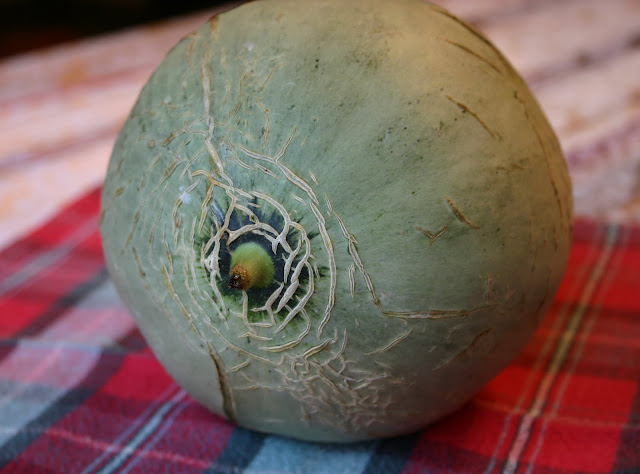
Meanwhile, out in the garden, I've harvested the two volunteer melons. One turned out to be a cantaloupe, the other, a French market melon of some sort I'd bought a while back. I never saw either vine or melon when I planted them two years ago. It either stealth-bloomed and ripened, or that is one long germination period!

Unfortunately, it wasn't very good. I picked it too early, worried about the cracks in the rind, and it did not continue ripening off the vine. It was pretty, though.

The cantaloupe was delicious.

As usual, the kitchen is infested with tomatoes. They sit on every surface, reproachfully. The cucumbers are approaching double digits outside. I'll have to bring them in today. Is it possible to make marinara sauce and cucumber vichyssoise at the same time?! One long day in the kitchen. . . .

Luckily, the king is on progress today, so I can work on the alto parts to Mozart's Requiem to my heart's content! September 11th we will mark the 10th anniversary of the death of so many that day 10 years ago, with a memorial singing of that work. It is a beautiful piece, which weaves its way into the warp and weft of your soul, somehow. I don't worry too much about which bits Mozart wrote, as opposed to other bits cobbled in by pinch-hitters after he died. But I can imagine him [Mozart] being overcome to tears by the beauty of Lacrimosa. . . . .

Here it is - although you have to listen through the Confutatis before you get to it. You'll know when you get to it. Never fear. But first, a little conflict. . . .


Wednesday, July 20, 2011

this year and last. . . .


Last year - this time - we were all about cucumbers. This year, it's all tomatoes again. I spent a good five hours yesterday blanching, peeling, coring and seeding a pile of all-ripe-at-the-same-time tomatoes until I couldn't fit any more into my largest pot! And it's a very large pot.

There are still 20 left over. What to do with them? More marinara? I don't know. . . .

No, there are no pictures of the pile of tomatoes. Unlike our first year here, they aren't really that pretty this year. I think it has to do with the uneven water supply (drought - then flood - then drought again), but many of them have cracks along the tops. It makes no difference when you're cutting them up anyway, but they aren't exactly photogenic, like I said.

I also want to get away from just narrating a series of pictures for a while. (OK, I'll give you one picture, at least, but I'd like to get away from the photo essay side of things and back more to the essay. There. I've put one right up top.)

Having denuded the tomato plants of any tomato even remotely approaching ripeness, I turned my attention to the other plants in the garden this morning. The weather has been brutal. It's been almost 100 degrees, with a correspondingly high humidity factor. Possibly the plants like it, but I can't take it and won't venture outside past 10 a.m., when the sun finally breaks over the tree line and floods the front pasture with its light and heat. That doesn't leave me with a lot of time to water in the morning, and it's still unbearably hot and muggy when the sun goes down at night having spent the whole day scorching the earth! Thunderstorms are daily predicted, but continue to hold off. Accordingly, the garden is suffering from lack of rain if not the heat.

Last night, after watering till almost dark, I reapplied the cayenne. The deer unfailingly come calling during droughts. As I cayenned, I discovered that the beans had been busy. I picked them this morning, careful with the bees so they'd be assured that theirs were the blossoms. . . . (that way there will be more beans for us!)

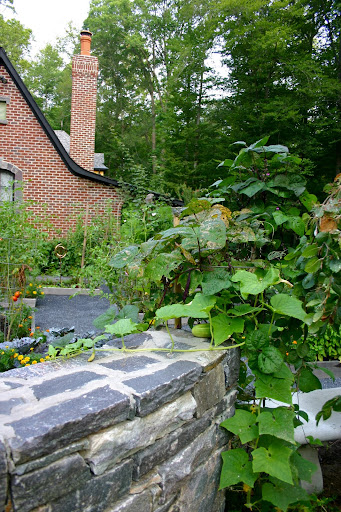
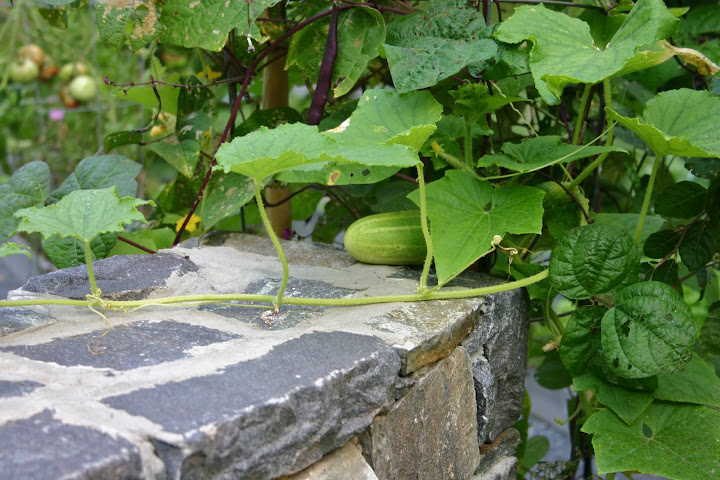
Remembering the bumper crop of cucumbers last year, I also inspected the cucumber patch. For some reason, they're not a prolific this year. . . . They're also a good deal more circumspect! They're not easy to spot under the best of circumstances. Somehow they can blend right in, lying right out in the open, under the leaves. But this year, they've outdone themselves. One had hidden itself in a boxwood, about a foot off the ground. Another had climbed the wall, and was hiding among the leaves on top of the wall! One does not expect to see cucumbers that high up.

So today, just three cucumbers, and I don't really see that many others in the pipeline. I've got several in the crisper drawer, though, and there should be enough for some cucumber vichyssoise. We've also managed a cucumber salad just about every night, so there's been plenty. Certainly, I have nothing to complain about. So many of my friends are telling me about the disaster their garden has been this year! We are feasting, here. The tomatoes may not be pretty (and may be covered in cayenne dust) and cucumbers not as plentiful as what I remember, but I haven't had to buy produce from the store in weeks. That is not counting vidalia onions and mushrooms, that is, which we don't grow but which are staples here.

Meanwhile, I am aware that disaster looms ever-present. The rain holds off, the sun scorches, the deer invade. . . . Yesterday, the king and I pulled enough gorging caterpillars off St. George to fill a large red pint cup! (St. George is the weeping beech tree out front, opposite what was the Dragon weeping beech - but the Dragon died, and has been replaced with a beech we call the Phoenix. As George slays dragons, we deemed it ill-advisable to bring in another dragon.) Having vanquished the Dragon, however, George was engaged by dragon-spawn. . . . and had lost a good many leaves to the little devils!

Overnight, one can go from feast to famine.

Today, however, we still feast, for which I am grateful.

There are many tomatoes still on the vine, including some from the 'volunteers' - those mystery plants that just sprang up. The volunteers this year have been extraordinary.

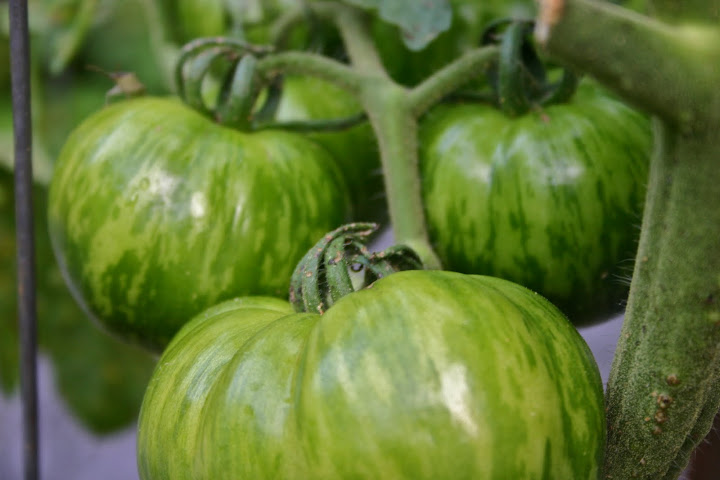
OK, let me give you one more picture. This tomato volunteer must have been from our first growing season, as it's a Black Zebra. I did not buy any Black Zebras this year, nor did I sow any seeds. But there he is! I was wondering what kind it would turn out to be. Aren't they pretty? And just in case you didn't catch the cucumber hiding in the picture up top, here's a close-up. The cheek of the little sneak! I'm hiding inside. Outside, it's hot, muggy, and toying with threatening thunderstorms. In other words: it's the height of summer.

Sunday, July 17, 2011

the aviary

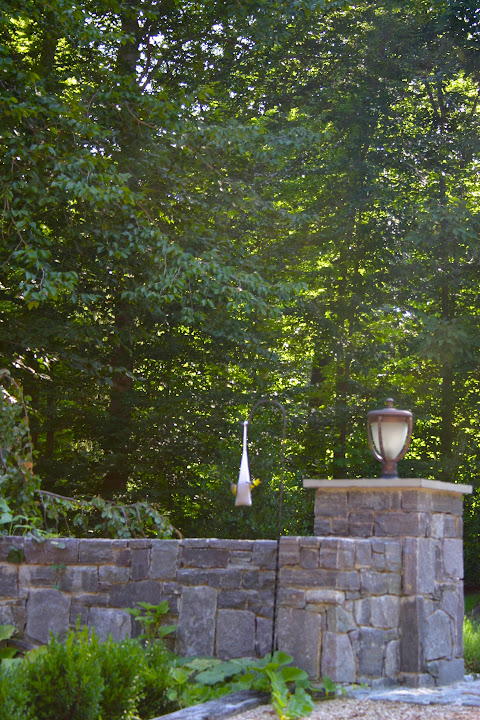
We put in a soft-sack thistle feeder to try and get a better look at the yellow finches we like to feed.

They were suspicious at first, but eventually started feeding there when we weren't looking. (based on the diminishing seed level)

Now, you pretty much have to walk right up before they'll fly off. Even then, they don't fly far.

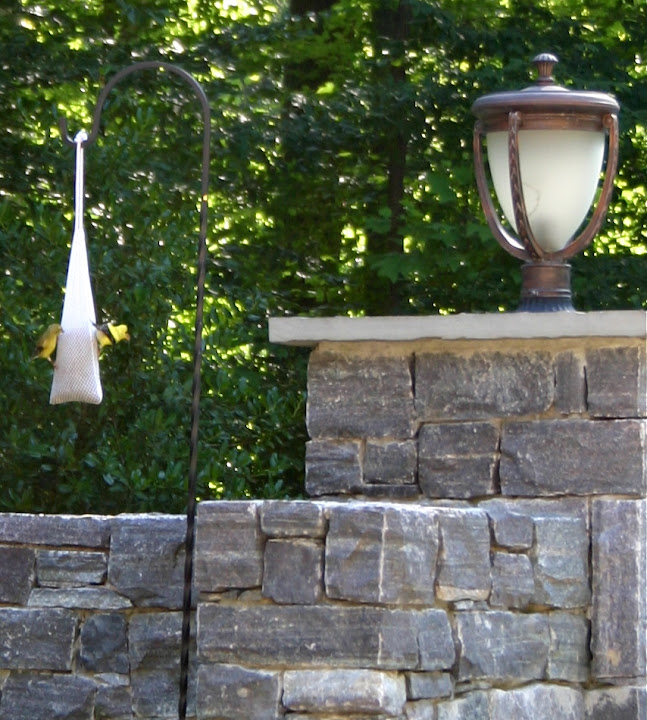
We've seen as many as 3 couples at a time, feeding or waiting their turn.

Here's a close-up of one couple: