Showing posts with label ponderings. Show all posts
Sunday, January 20, 2013
the pie pan and the rock
Dispatch from Puerto Rico - somewhere on the Northwest Coast. . . .
I sat for an hour watching the clouds scud across the sky, alternating sun and gray shade. The green and yellow parrots worked ferociously, breaking off the tips of bare branches, dumping excess weight, and then leaping into the air and falling a foot or more before their wings caught up with the excess weight of a branch twice their length in their beaks.
They flew to the highest palm tree, disappearing into the ball of fronds above, from which a cacophony of shrieks and squawks was emitted. At least 20 parrots must roost in the palm, and nest building and expansion or renovation was clearly underway. I amused myself thinking up conversation in the parrot talk.
"Wipe yer feet before you land, you big oaf!"
"Not there! Put that lumber on the other side. By the nursery! Sheesh."
"Whaddya mean there's no warranty on your labor? If one of my babies falls out of this nest, I'LL show ya warranty!"
"Did you hear what that other parrot roost is building?! You'd never believe. . . ."
Every conversation was a loud conflict, a quarrel, a garrulous query, gossip or dispute at full volume, but oddly sociable. No one feared for their life or reputation; divorce was not an option. Children don't get abused or abandoned and don't run off to 'find themselves' or do drugs.
Closer to hand, the Changos were getting bolder.They swell up into a squeeze box and make a wheeze, wheeze, wheeze - SQUEAK! with feathers ruffled into a big black ball and cocked tail. After the squeak, their feathers smooth to reveal a bird half the size. It's a courting and dominance display.
The smaller females largely ignore the show and quietly go about cleaning the deck of the croissant crumbs that have blown off the railing where we put them every morning for our little feathered friends. The males posture on the railing until only one is left. The rest scatter about the deck and on chair arms and trees, eating the crumbs contributed to by the lone male, who nervously eats on the railing, looking over his shoulder lest a challenger appear.
And yet the Changos are sociable, too. They all apparently roost in a large, low hanging tree - luckily at some distance. What a racket! During the day, though, or at least when confronted with croissant, they do not prefer to keep company in large flocks. They prefer to keep their treasure to themselves. . . . Only 5 or 6 Changos are to be found at any one time at our place, and they arrive dutifully every morning. They keep a companionable distance from one another. They all take regular turns at the the birdbath. There, they drink, bathe, and sometimes dunk their food.
The birdbath is of humble origin: a used, disposable pie pan. It's held in place by a good-sized rock which does double duty. It not only keeps the pie tin from flying off in the wind that comes off the ocean, it also gives the birds something to stand on when they bathe. Apparently, they don't like just hopping into water - they want to be able to walk in - and walk out. The rock is a splendid vehicle for this purpose.
I'd been reading about God's call on one's life, that His call comes from His nature and if we hear His call (which is NOT a given), our response is according to our nature.
The pie pan and the rock came into focus as a perfect example.
This particular pie pan had already been used, as I said. It was battered, and otherwise trash. Filled with water (which so often symbolizes the Holy Spirit) nonetheless it would blow away in the wind of earthly cares and storms. The rest of the symbolism fell into place. It was so obvious! Laughably so, in fact, laughter that left tears in my eyes.
The rock, of course, is the symbol of Jesus, who gives us a place to stand, provides ballast and a sure foundation. The end picture is of what would otherwise be trash - good only for the garbage heap (although these days, I should probably say the recycle bin) - trash transformed by being grounded in Christ and filled with the Holy Spirit. It is thereby turned into something good and useful and refreshing also to so many others.
The pie pan itself is not being honored for itself in itself. If it insisted on that, it should be thrown out. Likewise, we ourselves are not saved in order to be preserved as we were, but to be transformed. If we insist on remaining as we are - which we are free to do - we,too, will be thrown out. But neither is the final question one of utility alone. Here, the metaphor breaks down. It breaks down in a way that would take another posting to explain, and one which I'm not going to get into today. Or tomorrow either probably, for that matter. . . . Sorry, I'm kind of on vacation. At least where taking on Utilitarianism is concerned. That's real work.
Let me just say that our lives are not disposable pie pans. But they are like disposable pie pans if we are not grounded in Christ and filled with the Holy Spirit.
And let me also say that what Jesus said about what happens to salt if it loses its saltiness now makes a whole lot more sense to me. . . .
Meanwhile, the Changos neither toil nor spin, but dine richly on croissant.
Sunday, August 5, 2012
the cost of butterflies
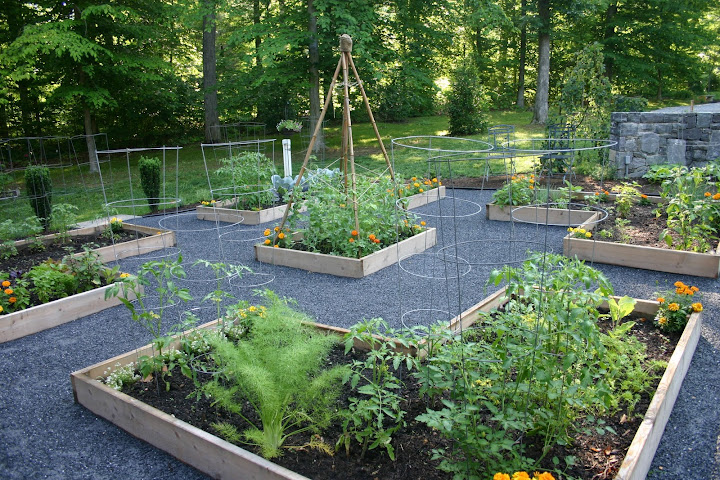
This year has been a breeze in the tomato garden. Not a single horned tomato-killer/piller in sight! I did see one dried out carcass which had been taken out by braconid wasp eggs. . . . It appears that I have broken the cycle here, at least for one year. If I have no hummingbugs, at least I also have no tomato hornworms. It's a price I'm willing to pay. We have tons of hummingbirds - I'll live with no hummingbugs.
Butterflies, on the other hand, I'd be sorry to part with. We have a plethora. Yellow ones, orange ones, black ones, blue ones, white ones. OK - the white ones are moths, technically. I've written about them before. They're the ones who decimate the cabbage. And the kale. Not the butterflies, of course, the caterpillars. But without the caterpillars, there are no butterflies. . . .
This year, I was a lot more tolerant of the damage being done to the cabbage and kale by the munching caterpillars. I had planted the cabbage among the basil and parsley, and if I used chemical warfare (the only thing that really works) that meant I couldn't eat the basil or parsley for several weeks. I decided to give up on the thought of controlling the caterpillars on the cabbage so I could eat the basil and parsley, and hoped for the best. Several of the cabbages succumbed, but several others made it to table and the kale yielded regular fronds for soups, salads, and veggie portions. And I've always enjoyed the white cabbage moths flitting about the garden. They're so cheerful looking! Maybe there's something to this 'live and let live' attitude after all.
I've been looking forward to the arrival of the big butterflies and in the last few weeks, they've come on in droves. The other day I was horrified, however, to see one of my sunflowers being systematically stripped of all its leaves by an assortment of caterpillars. All fuzzy, in a wide range of colours. My first thought was - yes - chemical warfare. Death to the destructos! My second thought was "well, if I want butterflies, I have to endure the caterpillars." I consigned the sunflower to its fate. The cost of butterflies. As it was, the caterpillars didn't kill the sunflower. They hadn't really started eating its leaves until the sunflower had bloomed, fed the bumblebees and started to fade, its petals drying to raffia and the middle of the flower turning to seeds destined to feed the songbirds here at the greenwood. A few of those seeds, of course, will be saved to plant in the spring. Cycle repeat.
No, it's not nice to have the ragged plant in my garden, ravaged by caterpillars, leaves turning yellow and brown where there are leaves at all. It's a small price to pay, though, to sustain the cycle. When the caterpillars had finished their work, they disappeared and I cut the sunflower down. I feel a bit like a murderer. They're taller than I am, with heads as large.
'Unless a seed falls to the ground and 'dies'. . . .'
There's no stopping the cycle at any one stage. The flower will wither and if I deny its leaves to the caterpillars, all I do is deny myself the joy of butterflies. And if I cut the flowers before they have been pollinated by the bees and matured, I deny myself food for the songbirds I love to see and hear, and seeds to plant next year. And if I will not harvest the sunflowers when they have dried and started to fall over, then the wind and the rain and the birds will scatter the seeds. They will either be eaten now, or rot, or if they hang on to next year, I'll be dealing with volunteer sunflowers in the paths and in between the boxwoods. They may or may not spring up where they are welcome and have sufficient soil to grow. Meanwhile, there are birds who will be looking for seed in the feeder in January and February.
Part of growing a garden, then, is tolerating ugliness. That is not at all what our culture says. Ugliness is to be rooted out. Sprayed. Eradicated. We can have it all, we are told. Beautiful fruit and leaves and seed - all at the same time - and never mind the cost. In fact, what cost? Life is beautiful. Just don't look behind the curtain. Don't question how the roses in stores are grown so big, so beautiful, with leaves with nary a spot or blemish on them. Or the sunflowers at the supermarket: each perfect, none contaminated by the touch of any bug, let alone the munchings of a caterpillar. I begin to see their perfection as a deathcamp. Neither fertile nor food. Poisoned. Their "beauty" pales when I consider what chemicals enabled it.
I have written before that growing one's own food has made me much more tolerant of imperfections. Now, I learn to tolerate even ugliness. Everything, in its season. We don't want the seasons, though, do we? We want the cool when it's hot, and the hot when it's cold. We want to be young forever, and to be wise without the years. We want to keep our options open and to be able to be where we are not. We 'conquer' time and space with facebook, skype and instant messages and wonder why we never really talk any more. Talk, sitting down, face to face, munching on the produce of the garden with the messiness of dishes afterwards and a greasy grill.
The cost of butterflies, indeed.
The title notwithstanding, I reject the utilitarian cost/benefit framework. No, I see this squarely within an Aristotelian conception of the good life, helping me to make sense of what I would not easily call "good" absent a wider perspective. It's the wider perspective which, in the end, leads to the transcendent, and the transcendent, to God. Because like the grass and the flowers, we, too, fade. . . .
Friday, July 13, 2012
lessons from the garden
Weeding and Watering.
As you may have determined by my last post, I have a laissez faire approach to weeds. If they are pretty and behave themselves, they may stay. If they're ugly, they get ripped out right away. Likewise, if they encroach, smother or otherwise impede the growth or flourishing of the lawful plants (read: beans, tomatoes, peppers, cabbages, basil, herbs, recognized flowers, etc.), they will be uprooted.
Today was an uprooting sort of day.
I learned last week, to my dismay, that a half hour or so of water every other day (or so) may dampen the top of the soil, but does absolutely nothing where it counts: deeper down, where the roots are. Another 15 daylilies had arrived from our friend Don at - what IS his farm's name again? Lily-something. The queenmum will surely supply it in the comments. Anyway, digging deep holes to place them in revealed the water shortage. A half an inch down, the soil was bone dry. I'd been making much of how much time I spend in the garden watering and etc., but it sure hadn't accomplished anything! Note to self: if you're going to water, you have to water. Water like you mean it.
Out this morning, watering like I mean it, I learned another lesson: weeding helps with watering.
As I watered, I absent-mindedly pulled out some grass and the occasional ugly weed. Their roots not only brought the dry soil to the surface, but also left an avenue for the water to soak down into the soil. I crouched down, then, with the hose, watering and weeding at the same time. Three hours later, my compost bin is full, my legs and back are a bit sore, and the garden looks refreshed - but the soil probably still needs another couple of hours' worth of water on it!
How I wish it would rain. . . .
More than ever, I appreciate the parables in which Jesus talks about gardening. Preparing the soil, pruning, good and bad fruit, dealing with seeds, fertilizing, weeding, watering - He talks about it all. And as I do all of those things in my little garden, I think about how He is doing all of those things in my life, in the lives of those around me, and all the way up to our country, other countries, and the whole world. There is a time for everything, isn't there? Well, I see some weeding and some watering in our future. And I'm going to spend some more time re-reading the gardening parables.
Saturday, March 3, 2012
words, pictures and facebook

Has it always been so that books have been lauded as a good way to educate, inform, inspire and entertain? I think so. Perhaps novels were not always so enthusiastically received, but that's largely changed in these times.
Television, on the other hand, is largely reviled, even as we all watch it. I read somewhere that 100 years from now we may well remark on this time as the great lost years, much as gin soaked - and sucked up - the life out of those who lived during the Industrial Revolution. I'm sure I book-marked that idea, but where? It's an intriguing premise. I wish I could tell you where I found it.
Both books and television serve as an escape, but we applaud the reader's escape, not the TV-gazer's. Perhaps the difference has to do with pictures. Not the single picture that adorns the frontispiece of novels (which usually look nothing like what you imagine of the hero or heroine), but the moving pictures which tell the story in movies and television, and thereby remove it from our imagination.
Books work with words and ideas, and require the interaction of the reader's imagination. We read; we think; we picture the story or the ideas in our imagination and it becomes real to us, and can be made real in our actions and by what we do as the result of what we have read and thought.
Movies do not require the same interaction. They require some attention, perhaps, but act upon us, rather than with us. I watch the recorded action as an observer and only imagine that I am a part of what I have observed merely because I have observed it.
Maybe the Biblical injunction against making images is about what happens when we set those images in front of a people that then stops creating, or even co-creating. Art doesn't make me just want to sit down in front of the picture, it inspires me to view things differently, to think new thoughts, or to change my surroundings or even myself. I begin to think that the difference between prohibited 'images' and art lies in where the life is. Is the life in the people viewing it or reading it? Or is the image itself held out as life, or held out as what life ought to be, somehow, if only we were right?
Years ago, north of Barcelona, I met an artist who hosted a conference on "kitsch" - which she defined as the attempted depiction of ultimate good, or heaven, even. Something bad happens when you try to capture that much reality in a single dimension. It turns on you and becomes not only dead, but deadening. "Virtual reality" promises more than reality - right before it robs you of any reality you otherwise had. Then it shows that it's dead and drab. No life; no colour.
I begin to suspect that something similar is happening on facebook. It promised more than reality: instant access to friends, family and a virtual community, any time and any place. But the easy re-connection with old friends now takes more and more time and gives less and less. We're like junkies, our faux-community requires ever-increasing facebook hits.
Facebook presents only the illusion of life. It gathers information about my internet habits by which to tempt me with ads for products I can buy to make my life complete. My friends and family gradually fall silent under the pressure of coming up with something clever to say or finding the perfect photo to show our perfect lives. Meanwhile, we post photos of puppies and kittens, slogans, and links to articles that are helpful, infuriating, or shocking. We link to people we don't know who've written about thoughts we no longer think for ourselves.
Life is face-time, not facebook. Ultimately, life is what happens outside of facebook.
This might be one 'book' that doesn't make the cut.
Meanwhile, if Downton Abbey were a book, I'd be reading it. . . .
Wednesday, February 8, 2012
building and book reports. . . .

Gretchen Rubin is a lawyer who clerked for Supreme Court Justice Sandra Day O'Connor, but gave up the full-time practice of law to write books. She's written several,
A lawyer myself, and a writer, and one who has also studied Aristotle in the quest of understanding more about what's important and what makes us happy, generally, I feel a bit of a kinship with Gretchen. Accordingly, I was quite interested when she listed Christopher Alexander's A Pattern Language
Paradigm shifts are energizing, don't you think? Picture standing on your desk, like the students in Dead Poet's Society - the view really is different! It can jumpstart thought, or give a flash of inspiration. To an artist or a writer - or anyone, really - it is a good thing. This was a book I wanted to read.
It turns out that The Timeless Way of Building
The book consists really of a single idea: that there are inherent 'patterns' in the way we live as humans, patterns which ought to (but often don't) shape the buildings, towns and cities we live in.
That's the book, in a nutshell. Alexander argues at length that we have lost our connection with those basic patterns, and that the current state of architecture and design is bankrupt. This is why, he argues, many of the spaces we inhabit are 'dead'. Dead spaces, he says, are deadening also to our lives. The converse is also true: that 'living' spaces inject life and freedom back into us. The trick is to become aware of the patterns which are "life-giving" and to re-incorporate them into our living spaces. But it's not just incorporating patterns that is important, it's about learning who we are, when we are least aware of ourselves. He does not advocate a slavish adoption of rules and patterns, he attempts to translate living patterns into language, which we can use in dwelling spaces much as we use words strung together as sentences. Ultimately, he says we transcend even the patterns, and that's well and good.
"The more I watch our pattern language being used, the more I realize that the language does not teach people new facts about their environment. It awakens old feelings. It gives people permission to do what they have always known they wanted to do, but have shunned, in recent years, because they have been frightened and ashamed by architects who tell them that it is not "modern." . . . The impulse to make windows overlooking life, to make ceilings vary in height, columns thick enough to lean against, small window panes, sheltering steeply sloping roofs, arcades, seats by the front door, bay windows, alcoves, [and hidden gardens] is already part of you. But you have been told so much, that you no longer value these inner impulses. You curb them, because you think that someone else knows better [or] that people may laugh at you for being so ordinary. A pattern language does nothing really, except to wake these feelings once again." [pp. 545-47]
The writing often feels redundant, and good examples are few. There are wonderful pictures of 'living' spaces, which the author fails to comment upon, happy to let the (often poor-quality) picture speak for itself. The pictures do speak for themselves, but I would have loved to have had the author's commentary about details, and help to see it even better. The value of this book is that the main idea is just so good. The drawback is that he spends more of his time trying to get us to agree with his main idea than showing us how it works, once we're on board with it. It's likely that the drawbacks I've listed here are remedied in the next book. Note, too, that this was published in 1979, and there are aspects that feel dated.
Gretchen Rubin is right: it will change how you look at things. I expect that I will spend years perfecting my understanding of the "patterns" that delight me, and which we incorporate into our lives and the spaces we inhabit. I wish I had known more about these patterns when we were designing and building here at the greenwood. . . . Especially about "window places" and "windows opening wide" and "sheltering roofs".
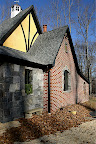
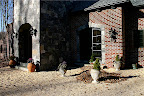
As it is, we have a good amount of roof overhang - every inch of which was hard-fought from first our draftsman and then our builder. I would have fought harder for certain doors to open outward. ("That's just not how it is done." I was told, and stupidly, I let it drop.) I would have brought certain window sills further down to floor level and incorporated a deeper sill. There, as I recall, I was told that the building code prohibited windows from extending too far down to floor level without. . . . whatever it was. We won the battle of the 'small window panes' - but were first subjected to comments like "But everyone agrees that picture frame windows are better than cutting up the view with lots of divided panes! You really want divided lights windows? You'll regret it. . . . ." I would have felt ever so much more secure if I had known of this "pattern" and how it makes people feel comfortable to dwell there. I could have withstood the criticism and implied ridicule ever so much easier. As it is, I feel somewhat vindicated now, especially as I also see the thickened walls, varying ceiling heights, steeply sloping roofs, the arcade, columns thick enough to lean against, and the seats at the front entrance. . . . Elements we included without having named them; elements we were made to feel vaguely ashamed of, for even wanting. It was not a matter of luxury, but a matter of feel. "Feel" is apparently not an element that is highly valued in the building trade.
For anyone wishing to understand a bit better how we inhabit the spaces we inhabit - and how we can better inhabit them - this is a great place to start. I think I'll have to bite the bullet and purchase the next one as well - A Pattern Language
- the one that details the 200 plus patterns Alexander identifies as significant in our gardens, buildings, towns and cities.
I'll report back once I've made my way through that one. Meanwhile, The Timeless Way of Building
Wednesday, October 19, 2011
darkle. . . .
There is such a word as "darkle" - a word I've put into the beak of a rhyming crow - and is in play outside today.
The word, that is, not the crow. It's a darkle day. . . .
Tuesday, June 7, 2011
the ethics of war on bugs
I have often said that if we had to kill our own food, there would be a lot more vegetarians. I don't like the idea of killing animals. I even balk at killing bugs. I chalk it up to my feminine sensitivity and innate nurturing quality. Yes, I know. It's sexist to think that women have innate nurturing sensitivities (and men don't). Get over it. Still, "live and let live" is wonderful motto. It doesn't seem fair to leave the killing to others and yet to partake of the food. . . .
Are things different when you are killing to protect your food?
Last summer I threatened violence against the deer. It was not because I intended to dine on the deer, but because the deer were dining on my day lilies and tomatoes! Worse, they were not even dining on the tomatoes, they were taking a bite, chewing it a bit, and then spitting it out.
Over and over again.
Apparently they didn't much care for tomatoes, but they kept tasting another one to see if perhaps they wouldn't change their minds. . . . You can read about it here.
I was ready to kill them. The depths of my rage surprised me. Luckily, I found that an application of cayenne pepper on the tomatoes, day lily buds and bean leaves discouraged the deer. All I had to do is to remember to reapply the powder after every rain. I forgot a few times, but the deer reminded me. All was well; violence was averted; peace and harmony reigned supreme at the greenwood. The deer may have been cussing me out, but they undoubtedly forgot soon enough. These are the same creatures that forgot from one tomato to the next that they don't care for tomatoes, after all!
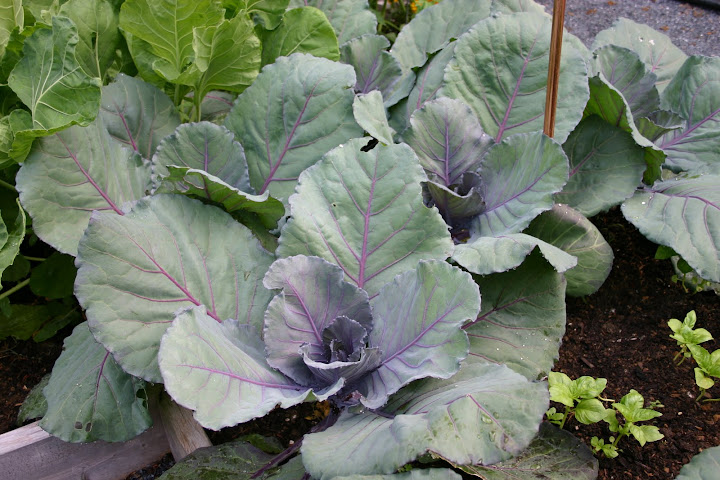
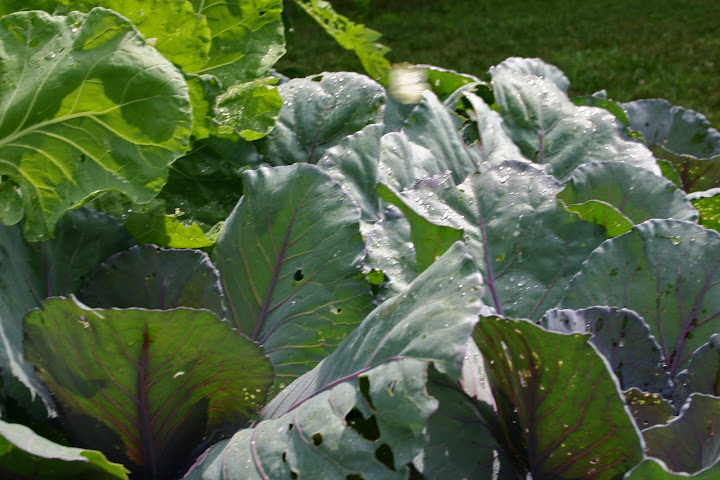
This morning, I resumed my lessons. The cabbage, which has been so lush in the garden this year (the above picture was taken a week or two ago) is now peppered with little holes.
Last year, I ignored the holes until they got really bad, then sprinkled some insecticide powder on the cabbage (trusting that the chemicals would indeed have worn off by the time the cabbage was ready to be eaten) and tried to ignore them again while hoping for the best. A week or so later, I noticed that much of the powder had been washed off. Looking closer, the developing heads were simply infested with striped caterpillars of some sort.
Yuck.
I reapplied the powder and continued hoping for the best. The 'best' was not very good. The caterpillars did not leave us much, and the cabbage was pretty ratty looking.
Then, once the second crop of tomatoes started coming in last year, I was shocked by the onslaught of horned tomato worms. One worm could decimate a tomato plant overnight. I spotted one enormous worm and pointed him out to my husband. Remember?
"Please kill him." I said.
"I don't garden." he reminded me.
Fair enough, but surely killing garden pests and invaders is manly work? He was not to be moved. I felt hugely sorry for myself. I'm a woman, not a bug dispatcher! I can't face that kind of violence. To be fair, it really is the gardening aspect that the king has drawn the line on. He dispatches every other kind of bug, no matter its size or scary description, in or on the house. Or close to the house. Just so long as it's not in the garden. . . . (which is close to the house! but that argument has not worked. Not yet.)
Meanwhile, the horned tomato worm continued munching on my tomato plant, which was just beginning to recover from the deer assault. I could practically watch the plant disappearing before my very eyes, from the top, down! I put on my garden gloves, clenched my jaw, squinted, and grabbed the miscreant. He held on! Little devil. I pulled him off and watched him try to stab me with his horn. When I bisected him with my trowel (1st covering him with leaves so I didn't have to see the 'gore') the trowel came away with green tomato gunk on it, which apparently was what the tomato worm had filled himself full with. I got mad. How dare this bug eat my tomato plant?! By the end of the week, the battle had been joined, and I was calmly dispatching anywhere from 1 to 5 horned tomato worms a day. I still won't step on the really big ones (yuck!) but I no longer require a leaf covering to cover the murderous deed.
Which leads me to today. Last year, I ignored the small holes in the cabbage until they got really big and then I dumped chemicals on them. I didn't learn how to kill caterpillars until the next batch turned on my tomato plants. The cabbage crop was pretty much a wash.
This year, I dispensed with the chemicals on the cabbage and started off by picking off the teensy caterpillars and squashing them. After the first 20 or so, I got out my surgical gloves and a cup of soapy water to drop them in. I put on my glasses so I could see. I'll resume again this evening after the worst of the sun's heat. I'm taking the battle to the enemy where they live. This is my garden, and I planted the plants. I get to eat them (the plants, that is), not the bugs! (Meaning that the bugs don't get to eat the plants, either - and I'm not eating bugs! Those pesky indefinite references.) It's a clear case of my sovereignty over the garden, enforced by superior power in the matter of chemical and traditional warfare. I feel bad about it, though. I am endlessly tempted to try relocation programs or even to sacrifice one of the cabbages to the worms in the interests of fair play.
They are not interested in one sacrificial cabbage, however. With them, it's all or nothing.
I live and learn. When it comes to the garden, I do not "live and let live." Garden pests are to be ruthlessly exterminated. It makes me sad, though, to learn that the cheerful little white moth/butterfly I've been enjoying watching flutter around the garden - you know, the cabbage moth - has actually been busy laying thousands of eggs which, when hatched, will start munching their way through my produce. I regret thinking that I have yet another enemy to seek out and destroy. And actually there are two kinds, the cabbage moth, which produces green gray striped worms, and the white cabbage butterfly which produces light green worms. Last year apparently we had only the cabbage moth. This year, we've diversified and have both. Great.
I wish we could all just get along. Some wars must be fought, though, if you want to eat. It's hard and violent work, trying to be a vegetarian! I don't think I'm ready to give up the supermarket meat counter just yet. . . .
Depending on the outcome of my war on bugs, I might not be giving up on the supermarket produce counter, either.
Tuesday, March 15, 2011
learning to knit

Overheard this weekend at the Greenwood:
"How long have you been knitting, J__?"
"About 20 minutes."
"No, I mean how long have you been knitting? When did you learn?"
"20 minutes ago. Queenie just taught me."
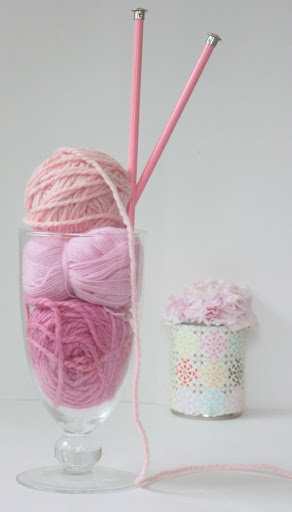
I don't think I've ever taught a more apt pupil. (Sorry, M__. You may have been surpassed. We'll see.) In any event, J__ showed up, large with child, bearing her "knitting" supplies, which turned out to be pink acrylic and an assortment of crochet hooks. I explained the difference, produced some knitting needles and was silent about the colour choice, given the expected boy. Yes, there are two girls already. Either she - or he - will get used to it.
She mastered holding the yarn and needles at the same time right off, a trick I've seen people struggle with for weeks. I had cast on - and knit - 25 stitches, with the idea that we would start small. If enough 4x4 squares were produced, we could always make a baby blanket. If not, at least she would get a few rows under her belt, without bogging down in the middle of a 125 stitch row!
"I'll show you how to cast on later, when [silently:"if?"] you start your second square. Let's get you started with the knit stitch first, before you worry about casting on, which you won't do as often."
I demonstrated. Then, handed her the needles.
It wasn't completely clear sailing from then on - there were several "adjustments" - but 20 minutes later, J__ was struggling manfully with several inches of knitted fabric to show for it, and looking every inch the knitter! Especially to one who doesn't knit himself (the king) who was the one who asked how long she had been knitting.
By the end of the weekend, there were two (almost 3) finished squares. (Oh, and she'd learned to purl as well!) I demonstrated the mattress stitch to sew the squares together, describing other alternatives, and sent her home with a spare yarn darner. She promises to send pictures.
Nana taught me to knit when I was probably 4 or 5, the same age as J'__s eldest. Maybe J's girl will learn on the next visit, which won't be until well after her brother is born.
What I didn't learn until many years later was how to finish my projects. I would get bored with them and put them aside. Sometime later, I'd start a new project, rather than finish the one I'd started a year or more earlier and was heartily sick of. Thus, I had a lot of knitting experience, but not so many knitted objects to show for it.
One finished object I do remember was the knit suit I made for the queen mum. Yes, "suit". There were two immediate problems with it: one, it was made of acrylic. A lovely brown "tweed", but acrylic. Second, the cast-on edge for the pullover top was too tight. It was almost impossible to pull on/pull off. A third problem - had anyone ever actually worn the thing - would undoubtedly have been that it was way too warm to wear anywhere south of the North Pole.
That was over 30 years ago. I have learned several things since then!
First, if you're going to spend all that time making something by hand, work with the best materials possible. For me, that usually means natural fibers. Yarns for hand-knitting are becoming ridiculously expensive these days, but there's little sense in spending months knitting an acrylic "tweed" suit! A good source for inexpensive basic yarns in a rainbow of colours is Knit Picks. I have also been known to keep my eye out for otherwise ugly sweaters (XL if possible!) made from fine materials on sales racks or in thrift stores. You have to be careful about that, though, because some sweaters are actually made from knitted "cloth" which is then cut and sewn together, and which can not be unraveled into a single long strand and recycled into another knit garment. The 'cut' kind unravel like the warp/weft of cloth, into short un-reusable lengths. The better sweaters are usually piece-knit, and can be unravelled. One learns to tell the difference, but I still won't pay much more than a few dollars for a sweater I intend to recycle into wool. There are too many variables and uncertainties.
Second, "fix the problem"! Again, if you're going to spend all that time making something by hand, don't let it languish in a drawer because the neckband is too tight! Take scissors to it, if necessary. There's a lady called Elizabeth Zimmerman (often referred to as EZ by knitters) who really changed my whole attitude about knitting. Her book Knitting Without Tears can be summarized by a quote she is famous for: "Knit on with confidence and hope, through all crises!"
She just didn't get upset about anything. She also didn't let her knitting rule her; she ruled the knitting! There's a difference. Learn it.
What I would do now about the too-tight cast on edge would be to cut it off (yes, using scissors), pick up the stitches and re-knit it (going the opposite direction) and then cast off using Jeny's surprisingly stretchy cast-off binding. Elizabeth Zimmerman liked the sewn bind-off, but I have learned from her to use what I like. I think she would have liked that.
Fixing the problem means re-positioning the buttonholes, or ripping out the wierd peplum, or changing the turtleneck to a boatneck if the yarn makes you sneeze, or lengthening the arms, or any number of other adjustments you know need to be made if you're actually going to hope to wear the item. You know the problems the minute you put the garment on. Fix it! Or get rid of it.
About finishing projects. . . . well, the more projects you finish, the easier it becomes to finish them. I don't know why that is, but it is. Write it down.
There are a host of knitting resources available now on the internet. Some of my favorite sites are Ravelry and Knitty, and through them, you will come across a bevy of knitters, designers, bloggers and videographers who have posted amazing material dealing with just about every technique or problem you could ever dream up. You will come across names like Jared Flood of Brooklyn Tweed and Shelter yarn, which I plan to spring for, one day soon. There's Stephanie Japel, who I first met when she knit and designed and blogged under Glampyre Knits. There's Norah Gaughan and TechKnitter and Ann Hanson, who knits, designs, cooks and gardens. (and has a logo involving a skewered martini olive on a knitting needle. Gotta love that!)
I haven't even touched on what's available on YouTube!
But I've reached the end of my concentration span and in the spirit of finishing projects, I'm going to finish up here, and hit "Publish Post". I have noticed that I haven't written much lately. Too much knitting! [grin]
Talk soon.
Tuesday, August 17, 2010
the malevolent hummingbug
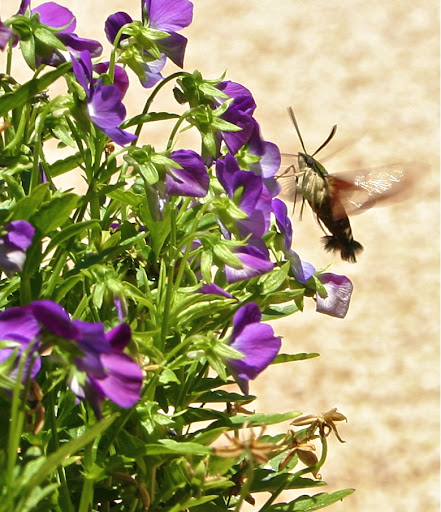
I was thrilled the other day to see what appeared to be a miniature hummingbird buzzing the violas that were still braving this summer's intense heat. Upon closer examination, he appeared to have antennae and legs. A hummingbug? Cool!
On the other side of the garden, I've started having to police the tomato plants for enormous caterpillars which - overnight - can defoliate the entire top of the plant.
I hate those things! They hold on to the plant when you try to pull them off, spit green juice at you, and have a thorn-type horn at one end which I'm sure they would deploy if I didn't wear my garden gloves! The detection and destruction of these invaders caused some domestic discord here at the greenwood. I was happy to detect them, not so happy to squash them. I'm squeamish that way. Actually, I should say that I was squeamish that way. . . . The king had made his refusal to garden well-known, upfront, so I can't really blame him for refusing to help me fight disgusting caterpillars in the garden. I did rather think that he would take pity on my girly sensibilities and dispatch the creatures for me, once captured.
Apparently not.
Feeling very sorry for myself, with the first one I went out, routed the worm, threw him on the compost heap, covered him with a leaf and bisected him with my trowel! No sweat; no muss; no gory details. I then thought about how our society insulates us from most bad stuff to the point where we either deny that bad stuff exists entirely, or run screaming from the room in horror when we can not ignore it. Farmers have no such luxury. A caterpillar chomping on a tomato plant can wreak havoc in a half hour. If you wish eventually to eat your produce, spraying deadly chemicals on it is probably not the answer. Killing is.
I never really thought I'd come to the point of saying that killing is the answer to anything. This, in spite of the ancient wisdom that there is a time for everything. . . . (and no, having planted even 20 tomato plants does not really qualify me as a "farmer", but I am learning some farmer lessons, I like to think.)
Anyway, I dispatch anywhere from one to six of these things a day now. They can be hard to spot, sometimes, but you develop a knack for seeing them after a while.
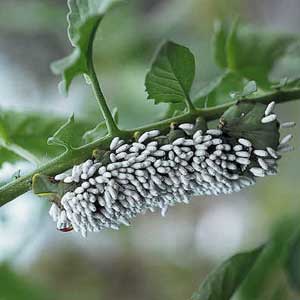
Imagine my horror when, instead of the usual green goblin, I got a green guy covered by white egg sacks?!!!
Oh! My! Blech!!!! YUCK!!!! I did NOT want egg sacks in the compost heap. I substituted suffocation by doggie-do bag for trowel bisection. That night, I did some research. What ARE these creatures who have invaded my garden?!I learned two things. First, the tomato hornworm grows up to be a moth - no surprise there - but it's the "hawk", "Sphinx" or "hummingbird" moth. The hummingbug!!!
Second, if you see the hornworms with the white protrusions on them, you are not supposed to kill them. Yes, that's correct, folks. Don't kill them because those aren't hornworm eggs on them, they're wasp eggs! Yay! And the wasps will kill the hornworms! Yay!! So let's have more wasps!!!
. . . like we need more wasps. . . .
Actually, it's a different kind of wasp they're talking about and I have resumed placing the parasitized hornworms in the compost pile. Good luck to those braconid wasps!
And that hummingbug had better stay out of my sight.
By the way, I think that the first full-grown, vine-ripened tomato will come off the vine this evening. It's been a long time - and 3 jumbo containers of cayenne pepper - coming.
Thursday, April 22, 2010
earth day, green beans and aquifers
In the news today: the Ogallala Aquifer is being depleted at an alarming rate. It turns out that the original survey report of the Louisiana land purchase may have been correct:
I do not hesitate in giving the opinion that it is almost wholly unfit for cultivation, and of course, uninhabitable by a people depending upon agriculture for their subsistence.
We, of course, have found ways to grow things on the Great Plains for some time now, but it appears that time is running out. Dave Thier's article to that effect is here, together with the fearful implications of what happens when we can't grow things there anymore.
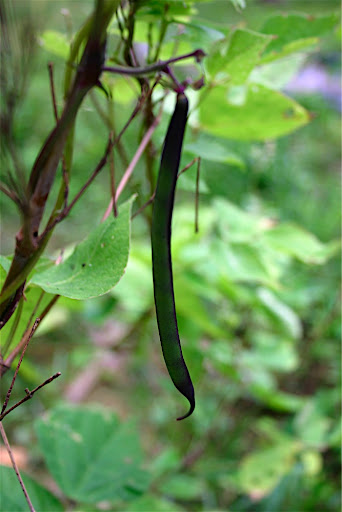
Meanwhile, I have been advised that one bean plant produces only about 12 beans per plant; twenty, at best. If I'm going to want to eat my own beans this summer, I'm going to have to have a lot of bean plants! And no, I had not considered having a bean-box-garden. There will be some beans, of course, but other things, as well! Tomatoes, lettuce, hot peppers, artichokes, carrots, radishes - I fear there will be no room for flowers. . . . I'm putting beans in wherever I can tuck one away, though.
It's harder to be self-sufficient on the land than one would think. Especially if one lives in a greenwood and wants keep the 'wood' part of it. This is a little depressing.
Happy earth day, whenever it is!
Thursday, March 11, 2010
lampshades, large and small

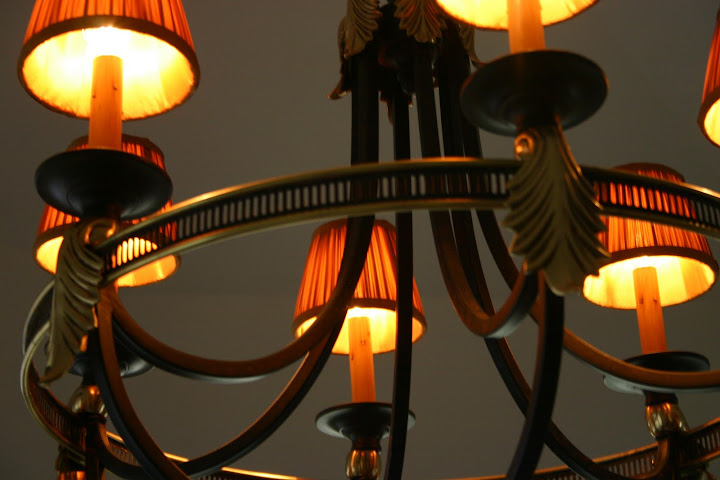
The king finally took matters into his own hands and brought home these lovely shades for the the lamp just off the kitchen. It has warmed the room up nicely. One day, perhaps we'll actually inhabit that room in some meaningful way!
It just hasn't happened yet.
I think it started with its name. I have read [by someone who unfortunately never gives footnote references] that Einstein said the most important thing anyone could do is to name something. I have not named this place. Mea culpa. I refused to call it a "nook". I hate that word. I hate it at least when fancifully applied to rooms as in "breakfast nook". Unfortunately, I never came up with an alternate name so by default it became the noddanook as in "It's not a nook!"
Whether or not Einstein ever opined on the importance of naming things, when you don't have a name for a place, it's hard to say something like "Let's dine in the __________."
And that's a shame, because it's a lovely spot. It's a lovely spot with an inviting table, which invites stuff to be placed on it as you walk in. On any given day - in addition to the standard issue candles and plants - it accumulates the mail, gloves, sweaters, hats, scarves, recycling, party-ware, boxes. . . . anything that comes in or goes out seems to spend a bit of time first on the table in the whatever-you-want-to-call-it-(except-a-nook!) room. There's nothing on it now, but that's only because we have houseguests. I cleaned it off yesterday, and found exactly what I listed above. Come growing season, you'll also find trowels, garden gloves, herb snips, seeds, pots, and garden notes and catalogues.
Anyway, the king was convinced that the reason we don't use it was because the light is too bright without shades. The only problem was that I really wanted these other shades [click on link to see], but couldn't see my way clear to paying - wait for it - $90 each. Wow! I think they went up! They were something like $68. . . . Well that settles it, then! $90?!!! This is a wee chandelier shade we're talking about, here, and I'd need six of them! That's just ridiculous. No more secret pinings for those MacKenzie Child's Courtly Checks checkered shades. Although I might improvise a small checkered border. . . .
The king was right - shades really warm the room up. We still need a name for this room, however. Any suggestions? Do I have to run a contest to get help, here? Probably. Contests seem to bring people out of the woodwork. But that's another conundrum. For now, I'll just ask. Any names?
Monday, November 23, 2009
good news - bad news (thoughts on knitting)
The good news is: I found the mistake in my current knitting project, which is the re-knit of a circular woolen shawl I started 4 or 5 years ago.
The bad news? It was a major mistake, some 20 rows earlier. It was not something I could just fix-and-go, or adapt the pattern on the fly. It needed to be ripped out, and re-done. Thank you Elizabeth Zimmerman, EZ to her many 'friends' in the knitting world, for the confidence to do this! Ever since I read her book Knitting Without Tears I have manfully knit on (UNknitting where required) "through all crises" as she was wont to say.
And so it was today.
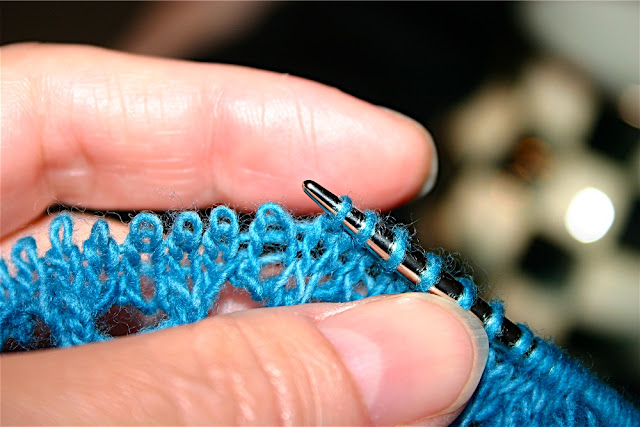
Before I could stop myself, I pulled the circular knitting needle out of the work and set the stitches free! Just as Elizabeth said, 'dropped' stitches don't run off. The worst they will do is to "slither down one or two rows, and cling there, moaning piteously, and waiting to be picked up."* See?
Knit stitches, off knitting needles, holding perfectly still for their close-up.
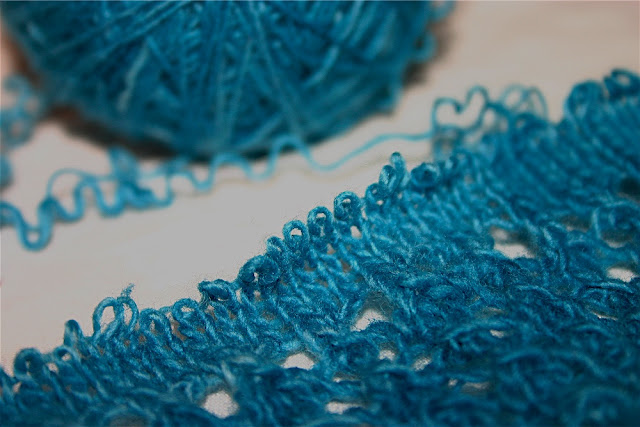
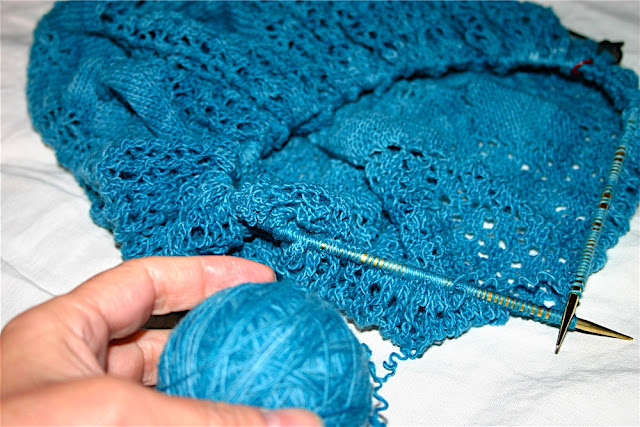
There's more good news. Having been pulled off the circular knitting needle, I could lay the the shawl still-in-progress out flat and actually see the pattern I have been taking on faith for so long!
I could also see immediately that I'd gone wrong because until I ripped out the offending 20 rows, the shawl wouldn't lie flat. Instead of increasing 4 stitches every other stitch (which is where those big holes are towards the top), I'd only increased 2. . . .
Alright. So I was traveling - heading to Corpus Christi to teach - I was coming to an "easy" bit of straight knitting, and as a result I only took a copy of the bit of the chart that I was immediately working on with me. This was a bad thing. I'm working from an old pattern, and the charting system can be confusing and even misleading. . . . Unfortunately, I never even caught my mistake until the pattern got complicated again, requiring me to really pay attention once more!
This is such a parallel to life. When things are tough, I pay close attention to everything so that I don't step wrong or head off in the wrong direction. As a result, I'm probably going to stay on track, even though [and maybe because] things are so hard and/or going so "badly". I relax when all is well. But it's when I'm on an easy stretch that I can find myself having gone terribly astray! More good news, though, at least when I'm unravelling 'easy' knitting, it's easy to pick up the stitches again to re-do. It really is hard to pick up stitches in complicated lace knitting. . . . I think that must be the same, too, in trying to correct missteps during the hard times of life.
Well, here we go, picking up the stitches.
And here you can see the shawl, back on the circular needle, all bunched up and hard to see again.
That's what it will look like until it comes off the needles - hopefully when the shawl is finally finished and not before!
And yes, I think my life is a lot like that, too. I can't always see clearly the design that is being worked into it. I have to trust that the instructions I have are good ones, that I understand them, that I'm working them out correctly, and that the small bit I can see right now is indicative of a larger more comprehensive pattern that will become plain [and which is beautiful] when it has been finished. There are these rare times when I might be given a glimpse of the larger picture, but it is usually as the result of a major set-back, requiring a do-over.
The longer I work on this project, the more incredulous I am at those who purport to work without a pattern in mind, without reference to a much larger picture than they will ever see. By that, of course, I mean not only this shawl, but also my life.
"Knit on with confidence and hope, through all crises."
Elizabeth Zimmerman (1910-1999)
*Elizabeth Zimmerman, Knitting Without Tears (New York: Simon and Schuster 1971) p. 41.
The bad news? It was a major mistake, some 20 rows earlier. It was not something I could just fix-and-go, or adapt the pattern on the fly. It needed to be ripped out, and re-done. Thank you Elizabeth Zimmerman, EZ to her many 'friends' in the knitting world, for the confidence to do this! Ever since I read her book Knitting Without Tears I have manfully knit on (UNknitting where required) "through all crises" as she was wont to say.
And so it was today.
Before I could stop myself, I pulled the circular knitting needle out of the work and set the stitches free! Just as Elizabeth said, 'dropped' stitches don't run off. The worst they will do is to "slither down one or two rows, and cling there, moaning piteously, and waiting to be picked up."* See?
There's more good news. Having been pulled off the circular knitting needle, I could lay the the shawl still-in-progress out flat and actually see the pattern I have been taking on faith for so long!
Alright. So I was traveling - heading to Corpus Christi to teach - I was coming to an "easy" bit of straight knitting, and as a result I only took a copy of the bit of the chart that I was immediately working on with me. This was a bad thing. I'm working from an old pattern, and the charting system can be confusing and even misleading. . . . Unfortunately, I never even caught my mistake until the pattern got complicated again, requiring me to really pay attention once more!
This is such a parallel to life. When things are tough, I pay close attention to everything so that I don't step wrong or head off in the wrong direction. As a result, I'm probably going to stay on track, even though [and maybe because] things are so hard and/or going so "badly". I relax when all is well. But it's when I'm on an easy stretch that I can find myself having gone terribly astray! More good news, though, at least when I'm unravelling 'easy' knitting, it's easy to pick up the stitches again to re-do. It really is hard to pick up stitches in complicated lace knitting. . . . I think that must be the same, too, in trying to correct missteps during the hard times of life.
Well, here we go, picking up the stitches.
And yes, I think my life is a lot like that, too. I can't always see clearly the design that is being worked into it. I have to trust that the instructions I have are good ones, that I understand them, that I'm working them out correctly, and that the small bit I can see right now is indicative of a larger more comprehensive pattern that will become plain [and which is beautiful] when it has been finished. There are these rare times when I might be given a glimpse of the larger picture, but it is usually as the result of a major set-back, requiring a do-over.
The longer I work on this project, the more incredulous I am at those who purport to work without a pattern in mind, without reference to a much larger picture than they will ever see. By that, of course, I mean not only this shawl, but also my life.
"Knit on with confidence and hope, through all crises."
Elizabeth Zimmerman (1910-1999)
*Elizabeth Zimmerman, Knitting Without Tears (New York: Simon and Schuster 1971) p. 41.
Monday, September 28, 2009
the pros and cons of getting out of the house
The summer is over. Granted, it's a beautiful day today, the birds are singing, and last night I saw another firefly. Two of them, in fact, one on each side of the lawn. I've never known them to linger so long.
Still, the summer is over. I can tell in the bug sound in the woods, where locusts have given way to crickets. I can tell in the trees, where a shimmer of red and yellow hide among the green leaves and hint at the explosion of colour to come. I can tell in the breeze, where a chill is on the air, even if I don't yet feel it on my skin. I taste it, somehow.
Tomorrow is my first day of class, so of course I've been dreaming of classrooms and teachers and lost lessons and waking up in the middle of the night to lie there, sleepless. Around me, a slowly-accumulating clutter has begun to irritate me. The picture frame that houses the couple shot of a couple that is no more. A slowly growing stash of knit baby clothes. A chemo cap knit for the wife of a friend whose cancer has killed her hopes of a baby. Another knitting project, almost finished, but with a mistake that will require ripping out the left front shoulder before I can resume. As it's a summer top, I doubt I'll be able to wear it this year, but if I don't finish it now, picking it up again next summer will require major study to figure out just how I put it together! Best to finish it now. . . . There's a stack of clothes to go to the thrift shop, and a silk kimono I bought years ago and thought I might finally start to wear. It's a small step to the clothes-to-go pile, but I doubt it will make it. Then, of course, papers and books. A wedding invitation, and a copy of Nana's remember-when's for her memorial service.
Time for a little order.
Still, the summer is over. I can tell in the bug sound in the woods, where locusts have given way to crickets. I can tell in the trees, where a shimmer of red and yellow hide among the green leaves and hint at the explosion of colour to come. I can tell in the breeze, where a chill is on the air, even if I don't yet feel it on my skin. I taste it, somehow.
Tomorrow is my first day of class, so of course I've been dreaming of classrooms and teachers and lost lessons and waking up in the middle of the night to lie there, sleepless. Around me, a slowly-accumulating clutter has begun to irritate me. The picture frame that houses the couple shot of a couple that is no more. A slowly growing stash of knit baby clothes. A chemo cap knit for the wife of a friend whose cancer has killed her hopes of a baby. Another knitting project, almost finished, but with a mistake that will require ripping out the left front shoulder before I can resume. As it's a summer top, I doubt I'll be able to wear it this year, but if I don't finish it now, picking it up again next summer will require major study to figure out just how I put it together! Best to finish it now. . . . There's a stack of clothes to go to the thrift shop, and a silk kimono I bought years ago and thought I might finally start to wear. It's a small step to the clothes-to-go pile, but I doubt it will make it. Then, of course, papers and books. A wedding invitation, and a copy of Nana's remember-when's for her memorial service.
I remember Nana always thought the same dragonfly came back every year to skim the pool. "Look! He's back!" she'd cray, and then warn: "He'll sew up your lips if you're not careful."I don't know why it's so, but going to work outside of the house is likely to result in a reduction of clutter. For one thing, less time to pull out things, get started, and then move on to something else. For another, order in one area of life tends to spill over into others.
Time for a little order.
Tuesday, August 25, 2009
no camera, will travel. . . .
I've been entirely too dependent on my camera, I'm thinking. I actually got to the point where I realized I was thinking "I have nothing to say, because I have nothing to show."
This is not a good thing from someone who fancies herself a writer.
So: I left the camera behind deliberately, and have headed to the West coast - Big Sur country - armed only with my words.
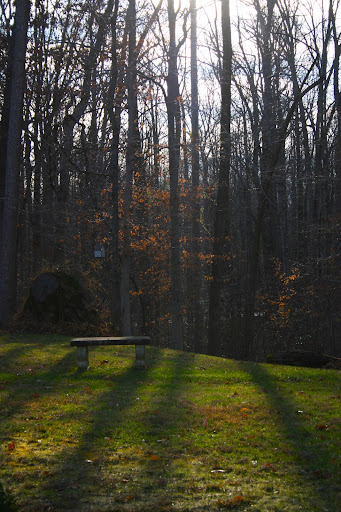
I'm a little out of practice. It's much different to look at my photos and compose a caption, which I now realize is pretty much what I've been doing for quite a while now: photo-essays. I throw in the occasional paragraph in between photos and hope I don't lose the show and tell audience. We're all part of the show and tell audience these days. What with links, and pictures, and google, wikipedia and youtube footnote opportunities, an unadorned script takes on the look of a formidable fortress.
At the same time, I am lamenting the no-camera status. Out here, the ivy grows like hedges, and the lavender is enormous! Plants I know as house plants flourish outside here in sizes unheard of while confined to a terra cotta pot. There's an historic "Arizona garden" (?) which has a sign warning you to stay on the path and not to bicycle or skateboard there, for your own safety's sake. I wondered about that - snakes, maybe? - until I saw the spikes and spines. Oh yeah. If you take a tumble into that little spiney patch of __________us horridas, you're going to know about it!
I'm staying in the erstwhile DelMonte Hotel. I understand that Pebble Beach (some 18 miles away) was built for this hotel. As were the two lakes here in Monterey. Everywhere I look there are pictures I would have taken. Pictures I would have expected to carry the burden of the words I no longer would have to wield.
But pictures can't convey the feeling of ten foot high windows with no screens and wavy glass, open to let in the cold night air coming in from the sea. They don't give you the feeling of 15 or 20 foot high ceiling and endless halls, of Spanish tile punctuated with colorful jewel-tone mosaic in fantastic shapes. A picture of a peacock is quite different than looking out my open bedroom window and seeing the peacock strolling in the magnolia grove just outside.
And no picture can capture the beauty I know resides at Big Sur - even though I only know that from pictures. . . .
I'm glad I did a little research on the weather ("Take a jacket, as it gets cold at night!") because even though it's August and on the beach, I have yet to appear without a jacket. It's a far cry from the East Coast on the beach this time of year. I can just picture (ha!) the wall-to-wall greased-up sea of sunburned people, dotted with sunbrellas, walled off from each other by sand crenallations molded from orange plastic forms.
When I get back from Big Sur, I'll see what words can do to show you the place. Meanwhile, I hear my friend the peacock. I had only heard that sound in films set in India before. Now I know that it's the peacock that is the sound of exotic movie sets. . . .
This is not a good thing from someone who fancies herself a writer.
So: I left the camera behind deliberately, and have headed to the West coast - Big Sur country - armed only with my words.
I'm a little out of practice. It's much different to look at my photos and compose a caption, which I now realize is pretty much what I've been doing for quite a while now: photo-essays. I throw in the occasional paragraph in between photos and hope I don't lose the show and tell audience. We're all part of the show and tell audience these days. What with links, and pictures, and google, wikipedia and youtube footnote opportunities, an unadorned script takes on the look of a formidable fortress.
At the same time, I am lamenting the no-camera status. Out here, the ivy grows like hedges, and the lavender is enormous! Plants I know as house plants flourish outside here in sizes unheard of while confined to a terra cotta pot. There's an historic "Arizona garden" (?) which has a sign warning you to stay on the path and not to bicycle or skateboard there, for your own safety's sake. I wondered about that - snakes, maybe? - until I saw the spikes and spines. Oh yeah. If you take a tumble into that little spiney patch of __________us horridas, you're going to know about it!
I'm staying in the erstwhile DelMonte Hotel. I understand that Pebble Beach (some 18 miles away) was built for this hotel. As were the two lakes here in Monterey. Everywhere I look there are pictures I would have taken. Pictures I would have expected to carry the burden of the words I no longer would have to wield.
But pictures can't convey the feeling of ten foot high windows with no screens and wavy glass, open to let in the cold night air coming in from the sea. They don't give you the feeling of 15 or 20 foot high ceiling and endless halls, of Spanish tile punctuated with colorful jewel-tone mosaic in fantastic shapes. A picture of a peacock is quite different than looking out my open bedroom window and seeing the peacock strolling in the magnolia grove just outside.
And no picture can capture the beauty I know resides at Big Sur - even though I only know that from pictures. . . .
I'm glad I did a little research on the weather ("Take a jacket, as it gets cold at night!") because even though it's August and on the beach, I have yet to appear without a jacket. It's a far cry from the East Coast on the beach this time of year. I can just picture (ha!) the wall-to-wall greased-up sea of sunburned people, dotted with sunbrellas, walled off from each other by sand crenallations molded from orange plastic forms.
When I get back from Big Sur, I'll see what words can do to show you the place. Meanwhile, I hear my friend the peacock. I had only heard that sound in films set in India before. Now I know that it's the peacock that is the sound of exotic movie sets. . . .
Thursday, July 30, 2009
mathematics
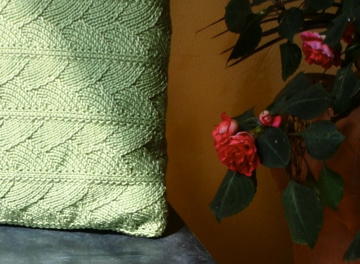
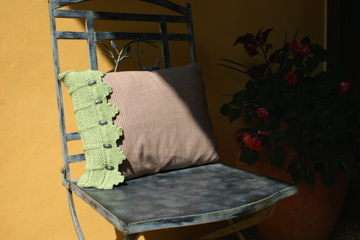
I saw a knitted hemp pillow online with a $570 price tag. (the one with the patch is only $525, I think it was. I'm still working out the patch bit. . . . 'now just why are we patching this new pillow? So that it looks old? and we pay more for that? And why was that again?') I liked the cable one, but $570?!
"Ridiculous!" I thought. "I'll make my own!" and so I did.
Two weeks later, I had my own completed pillow - in a beautiful celadon cotton.
At some point, I did the math: OK. Two weeks - but not full-time - but yes, probably a good 40 to 50 hours. If not more! (It's fine yarn on thin needles) and then the materials. Hmmm. At $11 an hour, that's just about $570 for the pillow. . . .
Not that the hemp pillow-people are paying anyone eleven bucks an hour to knit pillows for them, but that's part of the problem, isn't it?! Somehow we've lost our yardstick for what's valuable, and what's worth what. I couldn't make a living making and selling hand-knit pillows because there aren't many people willing to pay $570 for a pillow. And, quite frankly, I don't know that I would accept a job that paid $11 an hour. Yet there are other handmade pillows - knit ones, too - for a whole lot less than $570. That's where it gets scary. Somewhere out there, there are people knitting these things for a whole lot less than $11 an hour. They may even be knitting them for less than $11 a pillow for all I know. Meanwhile, we're getting used to thinking that hand-knit pillows shouldn't cost $570. . . . We fail to see the work that goes into it; we certainly have failed to pay for it!
This is what I get for re-reading Ayn Rand's Atlas Shrugged after getting my PhD. . . . Add Ayn Rand, the non-instrumentalization of another person (part of Kant's Categorical Imperative) and E.F. Schumacher's Economics as if people really mattered and you get valid worries over the price of knitted pillows online. . . .
Meanwhile, I've got my pillow,
to which I do not ascribe a monetary value. That's fine, so long as I don't fall off the other side of the horse and say that nonascription of monetary value is the same as a zero monetary value, or that there is no monetary value to be ascribed to the ability to create something that is beautiful, that goes beyond even the hours it took to make it.Thankfully, no, the pillow is not for sale.
Saturday, January 3, 2009
leaf piles revisited
It's been several days now, but the gratuitous leaf piles remain. I finally got a picture of them today. Here, the one outside the studio.
Here, the one outside the dining room.
This is the pile in the courtyard.
I promise you, these piles were not made by human hands. It's wierd to see something so 'precise' after such a violent windstorm. It reminds me of the example I've heard given of random evolution being like placing all the parts of a Boeing 747 in a field and expecting that, in thousands of years, a working jet could be standing there.
In any event, the roof and gutters are leaf-clean and here's a big picture of the three piles. The third pile is hard to see - it's in the shadow through the porte cochère. You have to walk under and through the arch to be able to really see it. Yep, probably much like what I was describing in my last post about the one pile of stuff we still have to sort through.
Here, the one outside the dining room.
This is the pile in the courtyard.
I promise you, these piles were not made by human hands. It's wierd to see something so 'precise' after such a violent windstorm. It reminds me of the example I've heard given of random evolution being like placing all the parts of a Boeing 747 in a field and expecting that, in thousands of years, a working jet could be standing there.
In any event, the roof and gutters are leaf-clean and here's a big picture of the three piles. The third pile is hard to see - it's in the shadow through the porte cochère. You have to walk under and through the arch to be able to really see it. Yep, probably much like what I was describing in my last post about the one pile of stuff we still have to sort through.
Thursday, January 1, 2009
another day; another year; another meal
A retrospective is not possible today.
It's probably not possible any time soon.
We still have house guests: one party that left for New Year's eve, another that came just for New Year's eve and left this morning (the former party returning), with additional guests expected this afternoon. From Christmas to today, we've done breakfasts and brunch, quite a few dinners, dealt with left-overs, and come close [once] to my goal of actually running out of food. Left over that particular night were only the pan-drippings and bones from the prime rib, a scant helping of mashed 'tates, and half a helping of an incredible croissant bread pudding for dessert. [WARNING: it's from Martha Stewart, but you can find the recipe here.] All the veggies were gone! Seconds were had by many of us. . . .
But to return to the non-retrospective: we've been learning about being a host, and how to be hospitable without being overbearing. My biggest question is how to excuse myself to do the clean-up! We've had guests now for over a week, and little time even to deal with the daily mess I make in the kitchen, not to mention the increasing clutter on the floor from dog hair, gravel and leaves being drug in from outside, and the imperceptible accumulation of fuzz that inexorably accompanies our lives.
Yesterday, we had help from 'outside', when the high winds rounded all the leaves up off the front meadow and off the roof and gutters (which the king had planned to assault with his ladder last weekend, but couldn't) and deposited them all into 3 piles. One is in front of the dining room, one in front of the studio, and one in the courtyard.
That's a bit what life has felt like this last year. After being blanketed with so many different things, a storm blew long and hard, and we ended up with everything 'done and dusted' and in 3 different piles. One: the house; finished and moved in. Two: the doctorate; finished, printed and bound. Three: the what-next; which is coming together surprisingly, although still a bit uncertainly. All I know is that there's a big third pile of 'stuff' out there that we're exploring. It looks like this next month will bring a new clarity.
Unless another wind storm pops up!
Meanwhile, the Rose Bowl starts in a couple of hours; I've made the smashed bean dip/hummos, put the tomato sauce to simmer on the stove, and should shortly be found in front of the fireplace dividing my time between knitting and watching instant replays of impressive runs. Time enough tomorrow to spend some time in reflection.
Happy New Year!
It's probably not possible any time soon.
We still have house guests: one party that left for New Year's eve, another that came just for New Year's eve and left this morning (the former party returning), with additional guests expected this afternoon. From Christmas to today, we've done breakfasts and brunch, quite a few dinners, dealt with left-overs, and come close [once] to my goal of actually running out of food. Left over that particular night were only the pan-drippings and bones from the prime rib, a scant helping of mashed 'tates, and half a helping of an incredible croissant bread pudding for dessert. [WARNING: it's from Martha Stewart, but you can find the recipe here.] All the veggies were gone! Seconds were had by many of us. . . .
But to return to the non-retrospective: we've been learning about being a host, and how to be hospitable without being overbearing. My biggest question is how to excuse myself to do the clean-up! We've had guests now for over a week, and little time even to deal with the daily mess I make in the kitchen, not to mention the increasing clutter on the floor from dog hair, gravel and leaves being drug in from outside, and the imperceptible accumulation of fuzz that inexorably accompanies our lives.
Yesterday, we had help from 'outside', when the high winds rounded all the leaves up off the front meadow and off the roof and gutters (which the king had planned to assault with his ladder last weekend, but couldn't) and deposited them all into 3 piles. One is in front of the dining room, one in front of the studio, and one in the courtyard.
That's a bit what life has felt like this last year. After being blanketed with so many different things, a storm blew long and hard, and we ended up with everything 'done and dusted' and in 3 different piles. One: the house; finished and moved in. Two: the doctorate; finished, printed and bound. Three: the what-next; which is coming together surprisingly, although still a bit uncertainly. All I know is that there's a big third pile of 'stuff' out there that we're exploring. It looks like this next month will bring a new clarity.
Unless another wind storm pops up!
Meanwhile, the Rose Bowl starts in a couple of hours; I've made the smashed bean dip/hummos, put the tomato sauce to simmer on the stove, and should shortly be found in front of the fireplace dividing my time between knitting and watching instant replays of impressive runs. Time enough tomorrow to spend some time in reflection.
Happy New Year!
Monday, September 22, 2008
moving days
It's hard to believe that this day has finally come. This morning, the vans arrived.
Much paper rustling, cardboard-boxing, taping and sharpie-pen-marking ensued. They were gone by noon. That's because I - queenie - packed up all my books, all by myself! ha!
We're still in dispute over whether or not the books will fill the bookshelves. This oughta be interesting.
Anyway, next stop - day after tomorrow - the greenwood.
I can hardly wait. Funny thing: one of the guys on the moving crew asked if we were moving to a bigger house. "Not really." I said. "It's actually a little smaller. Sort of. Well. . . it's one bedroom. On one level. But bigger rooms. So - sort of smaller, but bigger. Sort of."
He was done with the conversation a whole lot sooner than I was. We're moving to a strange house that's smaller - but somehow bigger. Sort of. It's hard to explain.
We're still in dispute over whether or not the books will fill the bookshelves. This oughta be interesting.
Anyway, next stop - day after tomorrow - the greenwood.
He was done with the conversation a whole lot sooner than I was. We're moving to a strange house that's smaller - but somehow bigger. Sort of. It's hard to explain.
Monday, September 1, 2008
simple stuff
Saturday, June 14, 2008
lessons from Luther - growing
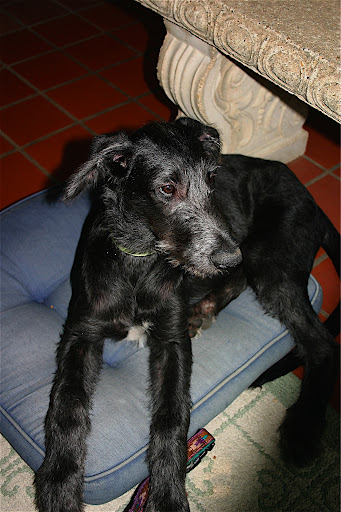
Growing is hard work. It's a full-time job. It requires full concentration when awake and lots of sleep when otherwise.
It does not require caution or proceeding slowly. That's what the humans are for.

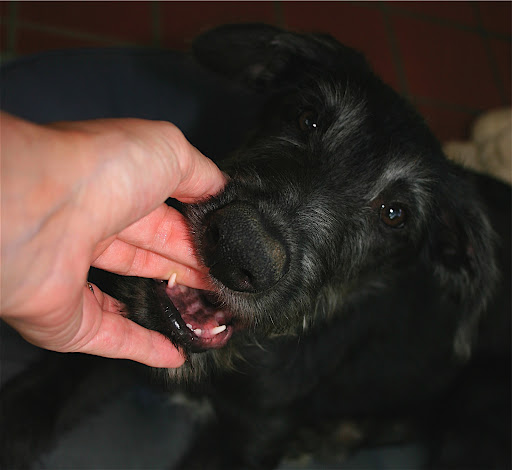
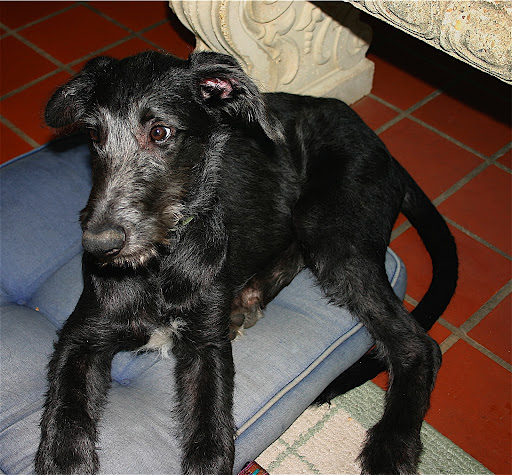
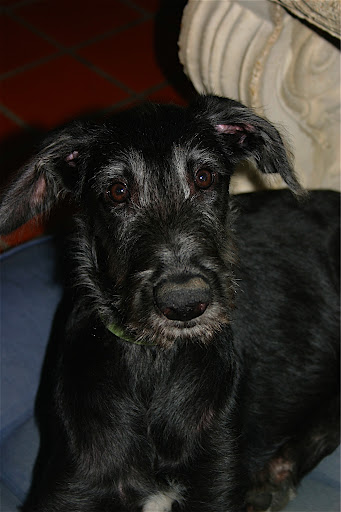
My Job: taste and/or eat as many things as caninely possible and chew on my human chew-toys.
Their job: run around after me, prying things that will kill me out of my mouth, setting things aright before they have toppled over and killed me, and producing small tasty treats whenever I have [momentarily - and completely accidentally, I assure you] done something that has either preserved my life or seems to be in accordance with the wierd sounds issuing from my people.
Generally, it's a howling nooooooooooo.

I only howl when I am alone and in need of consolation and the appearance of one of my humans.
They are very strange.
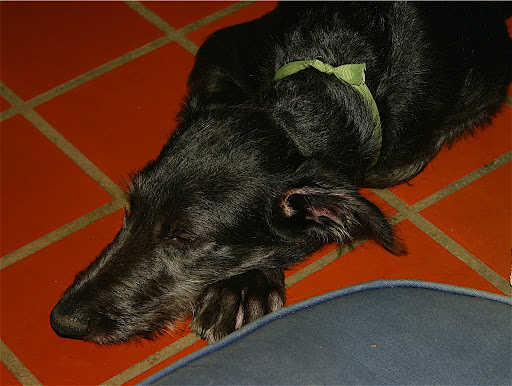
Meanwhile, I have to get back to growing. Like I said: full-time job. This part is the sleeping part. This helps me concentrate when I am awake. I have also found that I get my best growth-spurts while asleep.
I understand that someone sent the queen the exhortation to live life in such a way that Satan says:
Watch out, world! I'm awake. . . .
It does not require caution or proceeding slowly. That's what the humans are for.
My Job: taste and/or eat as many things as caninely possible and chew on my human chew-toys.
Their job: run around after me, prying things that will kill me out of my mouth, setting things aright before they have toppled over and killed me, and producing small tasty treats whenever I have [momentarily - and completely accidentally, I assure you] done something that has either preserved my life or seems to be in accordance with the wierd sounds issuing from my people.
Generally, it's a howling nooooooooooo.
I only howl when I am alone and in need of consolation and the appearance of one of my humans.
They are very strange.
Meanwhile, I have to get back to growing. Like I said: full-time job. This part is the sleeping part. This helps me concentrate when I am awake. I have also found that I get my best growth-spurts while asleep.
I understand that someone sent the queen the exhortation to live life in such a way that Satan says:
Oh shit. She's awake!I am trying to live in just such a way, myself.
Watch out, world! I'm awake. . . .
Subscribe to:
Posts (Atom)